
Onslaught: The Event that Changed Marvel Comics Forever Part 1
Onslaught turns thirty this year

Let’s take a little trip back in time. Specifically, let’s go back forty years to 1986. It’s typically regarded as one of the momentous years the comic book industry has ever had. It’s generally thought of as the beginning of the Modern Age of Comics due to the publication of Watchmen by Alan Moore and Dave Gibbons and The Dark Knight Returns by Frank Miller through DC. These were comics written for adults with mature themes and subject matter that fundamentally changed the way people viewed the medium. But those weren’t the only major milestones that year. Let’s migrate over from DC to Marvel. When it came to superhero comics in the 1980s, the X-Men reigned supreme. Chris Claremont had turned Uncanny X-Men into the flagship title for Marvel, and that success led to additional spinoff titles like X-Factor and New Mutants that were also selling like hotcakes.
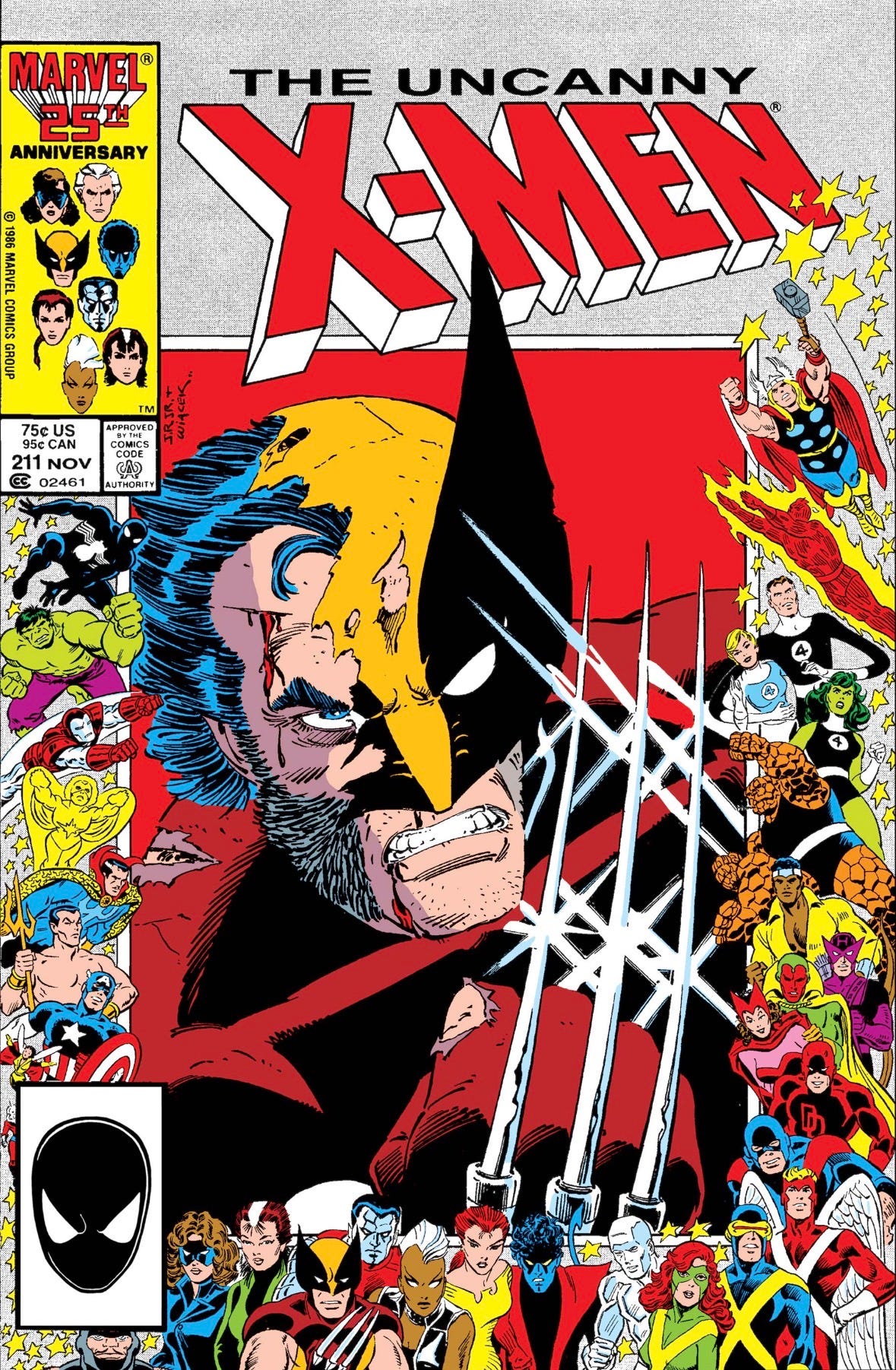
Entering autumn in 1986, you had Uncanny X-Men by Chris Claremont and John Romita, Jr., X-Factor by Louise Simonson and Walt Simonson, and New Mutants by Chris Claremont and Jackson Guice all operating mostly independently of each other when Claremont pitched a story idea to take place in Uncanny X-Men that would revolve around the systematic extermination of a society of mutants called the Morlocks. Louise Simonson liked the idea, but she thought it would be too unwieldy to take place in just one title, so she suggested that it take place in the pages of all three X-Men titles. “Mutant Massacre” was the name given to the story, and thus began the first big X-Men crossover event. It was a massive success, and Marvel editorial took notice. If the X-Men line was already the bestselling line in comics, and a crossover event made them sell even better, then wouldn’t having an X-Men crossover event every year be a major cash cow? Marvel clearly thought so because that’s exactly what happened. Following “Mutant Massacre” in 1986 were “Fall of the Mutants” in 1987, “Inferno” in 1988-89, “X-Tinction Agenda” in 1990-91, “X-Cutioner’s Song” in 1992, “Fatal Attractions” in 1993, “Phalanx Covenant” in 1994, and “Age of Apocalypse” in 1995. All of these events had been true X-Men events. They had little impact on titles outside of the X-Men line unless one of the creators involved wanted to loop in one of the other titles they were working on. That was about to change in a big way in 1996.
I want to provide a little context before going into the event itself. 1996 was the year that the comic book speculator bubble truly burst. I won’t get into all the gory details, but the comic book industry was in really bad shape. Things were so bad that Marvel would eventually file for Chapter 11 bankruptcy on December 27, 1996. That should illustrate just how desperate Marvel was for a big hit that year. The “Age of Apocalypse” event the previous year was a huge success for the X-Men line, so why not have the next big X-Men event pull in the rest of the Marvel Universe in the hopes that a rising mutant tide will raise all superhero boats?
The Road to Onslaught
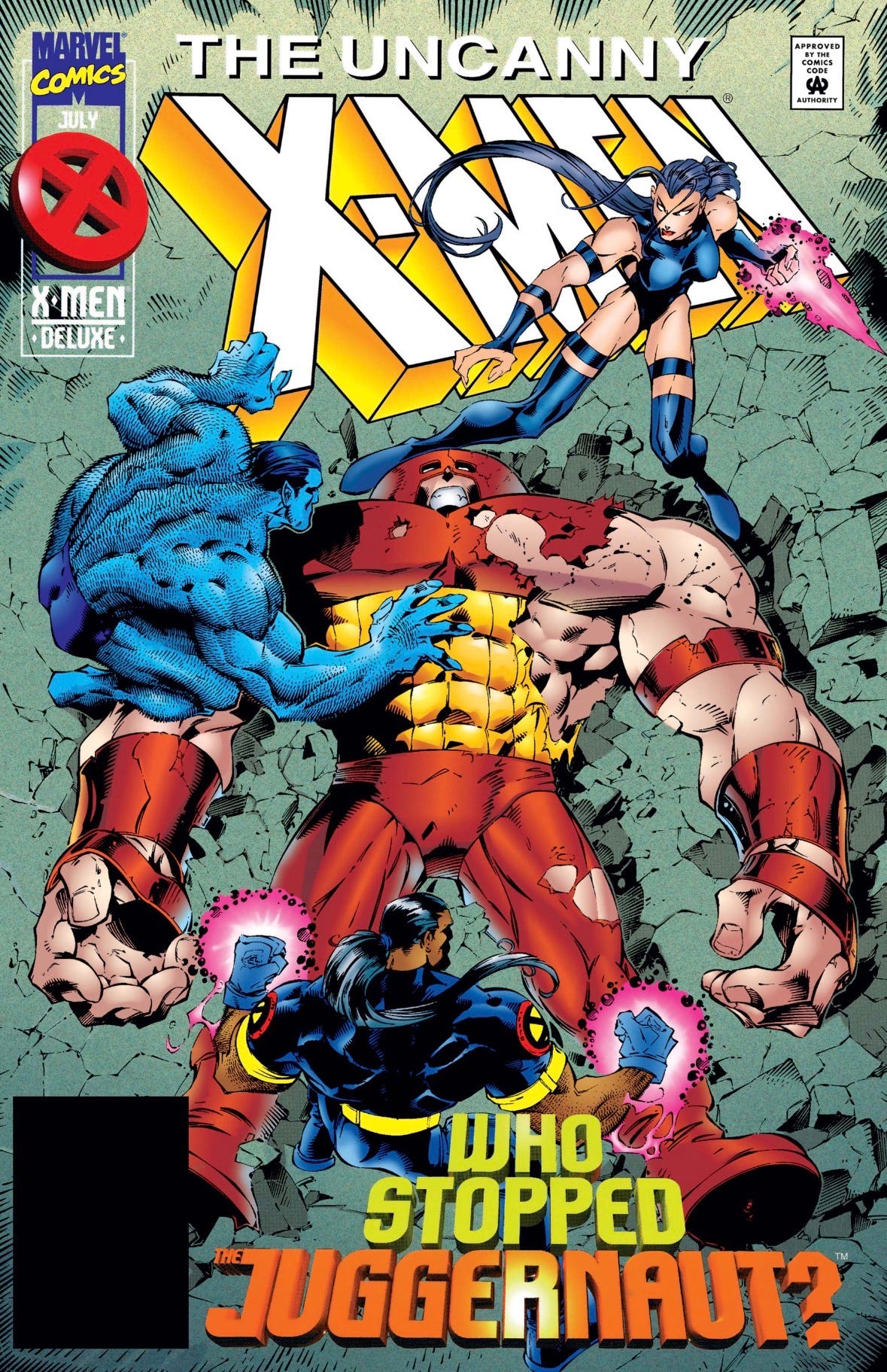
If you’re going to have a crossover event that is supposed to save an entire publishing company (or at least keep it afloat a little longer until you lure Jim Lee and Rob Liefeld back to the company), then you need a threat worthy of all of your characters banding together to fight it. So who or what would this threat be? The answer was obvious: Onslaught. Just kidding. This was not obvious at all because no one knew who the hell Onslaught was including the guy who came up with him in the first place. Confused? Allow me to explain. Scott Lobdell and Fabian Nicieza had been the two primary architects of the “Age of Apocalypse” event in 1995 as the writers of the flagship X-Men comics (Uncanny X-Men and X-Men respectively) at that time. Nicieza would leave X-Men shortly thereafter, so Lobdell would end up replacing him on that book on an interim basis while simultaneously remaining on Uncanny X-Men. During that time, Lobdell pitched an idea for a story that would eventually make its way into Uncanny X-Men #322 by Lobdell and Tom Grummett that was published in the summer of 1995. It’s a pretty simple story in which the X-Men battle Juggernaut after he crashes into the middle of Hoboken, New Jersey like a meteor. After settling the Juggernaut down enough to talk with him, the X-Men learn that Juggernaut had encountered someone in Canada who punched him so hard that he apparently flew up into the atmosphere and crash landed in New Jersey. Who could be powerful enough to do something like that to a heavyweight like Juggernaut? Onslaught!
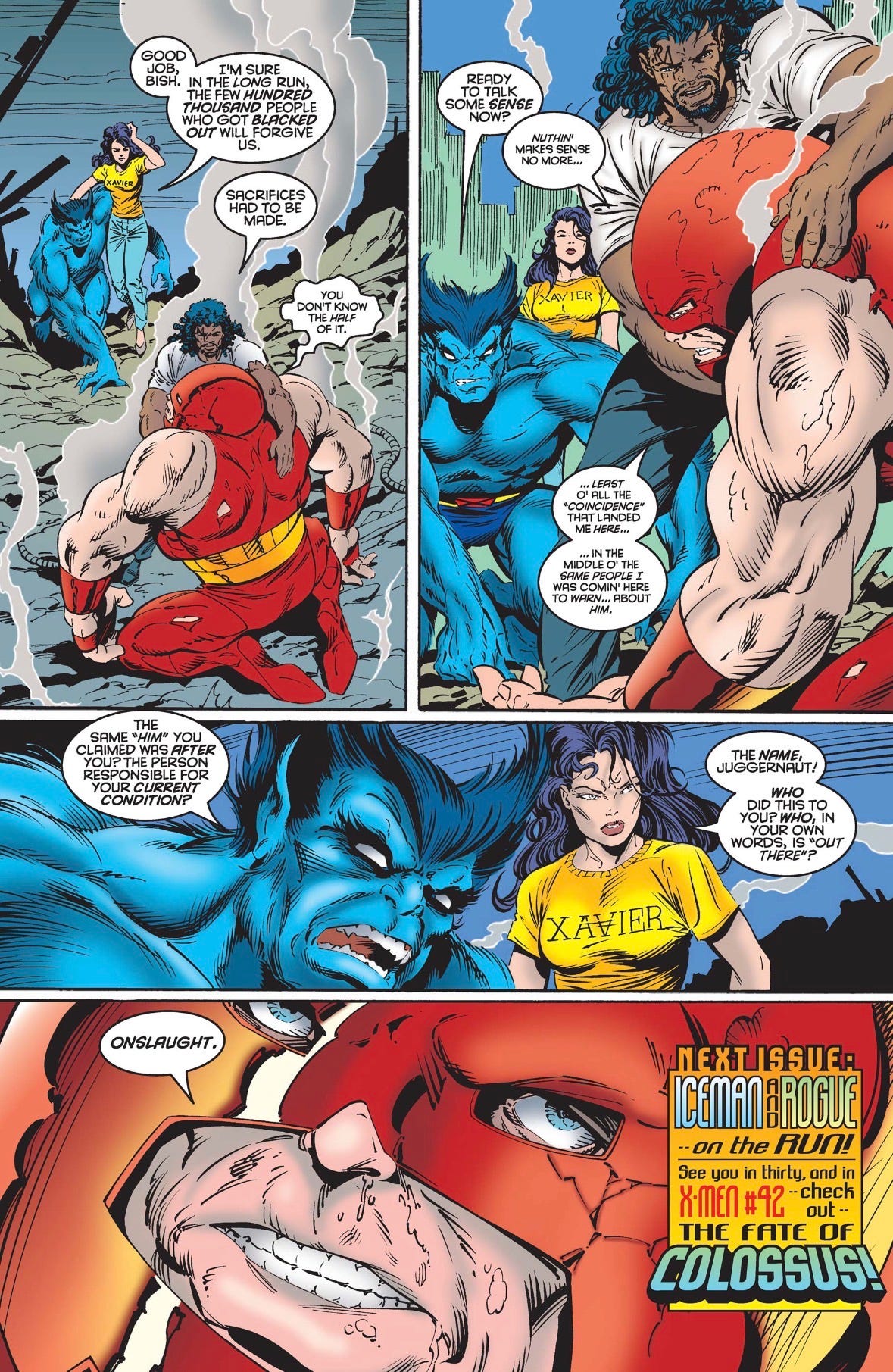
Here’s the thing about that story: Lobdell had no idea who Onslaught was. He just liked the idea of writing a single issue story about someone so powerful that he was able to scare Juggernaut. He had no real plans for the character beyond that. I’m calling this approach to comics the “Reverse Hickman.”
As I alluded to earlier, Marvel’s big plan to save themselves was to lure Jim Lee and Rob Liefeld back from Image to work on some classic Marvel characters who had struggled to sell comics in recent years. Jim Lee would be given creative control over new series of Fantastic Four and Iron Man, and Rob Liefeld would be handed the keys to Avengers and Captain America. The idea was that these properties would be split off from the rest of the Marvel Universe to be rebooted free from the decades of continuity they had accumulated in an attempt to appeal to new readers. It was basically the Ultimate Universe before the Ultimate Universe. Editorial had decided that the best way to split these characters off into another universe would be through a major event story. Since X-Men comics were the bestsellers at the time and had become accustomed to annual major events, it only made sense to have this event spiral out of the X-Men line of comics. Now they just needed a threat big enough that would require all of the biggest heroes Marvel had to unite to fight it. That’s when Lobdell stepped in. Onslaught would be the perfect threat for this event. Remember what he did to Juggernaut?! Now he just needed to figure out who he was.
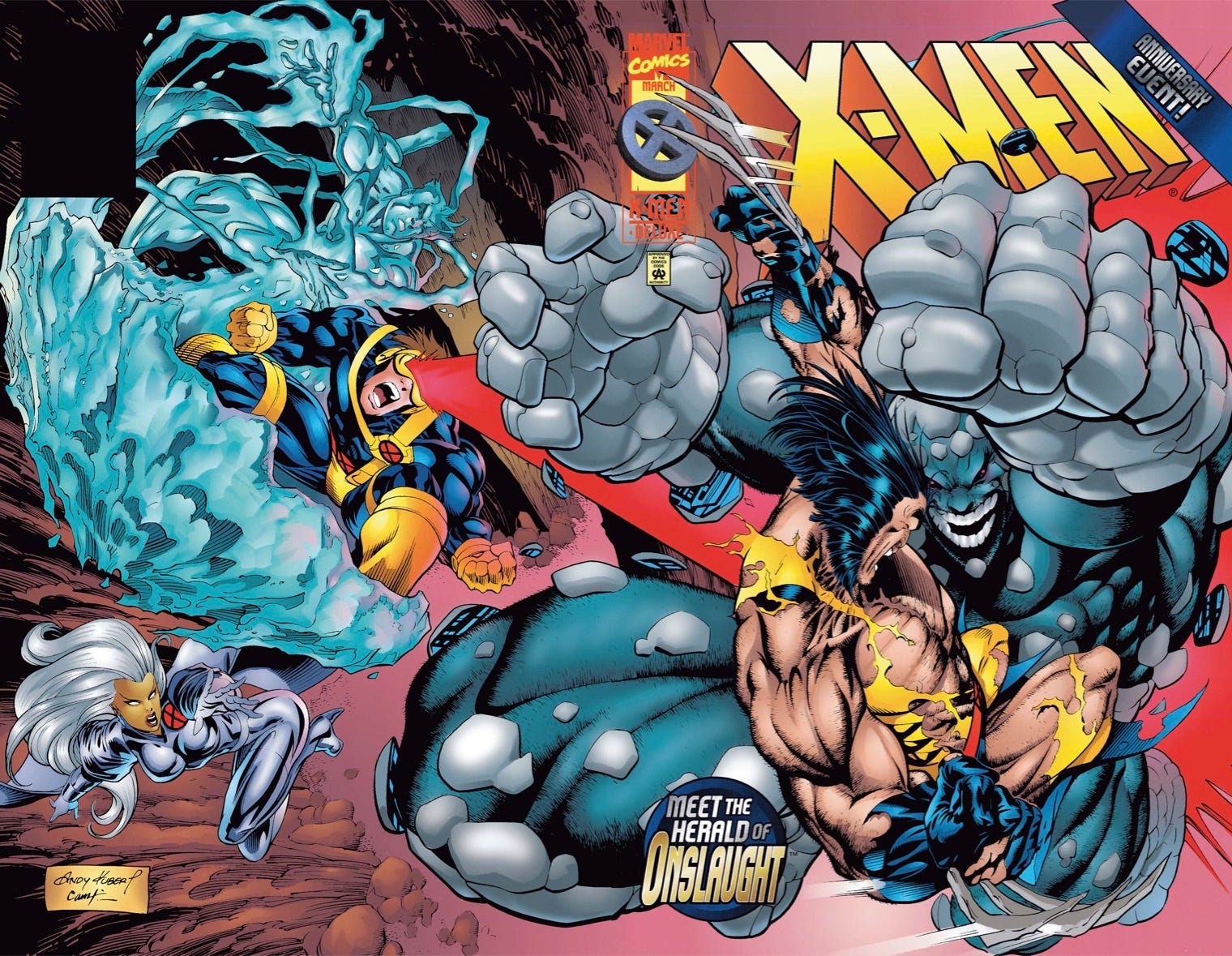
The next mention of Onslaught would appear in X-Men #50 by Lobdell and Andy Kubert. This issue would be all about the X-Men battling Onslaught’s herald: a mutant named Post. Never a bad idea to take inspiration from Jack Kirby who famously created the Silver Surfer as the herald of Galactus because anyone as powerful as Galactus ought to have a herald to announce his presence. I don’t have a whole lot to say about Post. He’s just a big guy with ambiguous powers who gives the X-Men all they can handle. The idea is that if one of Onslaught’s underlings is this tough, then how tough must Onslaught be? They’re really trying to build this guy up.
Onslaught: Phase One
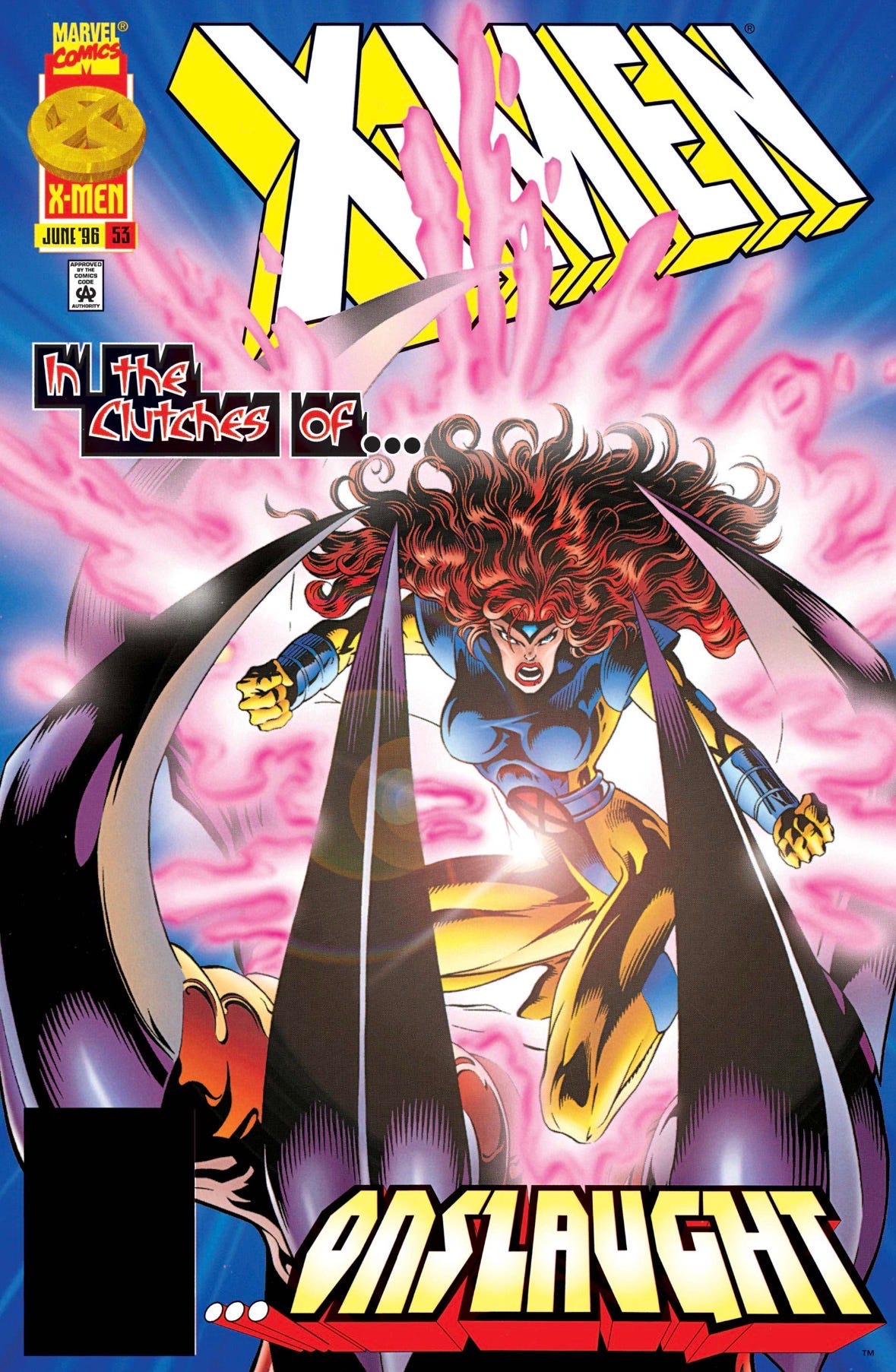
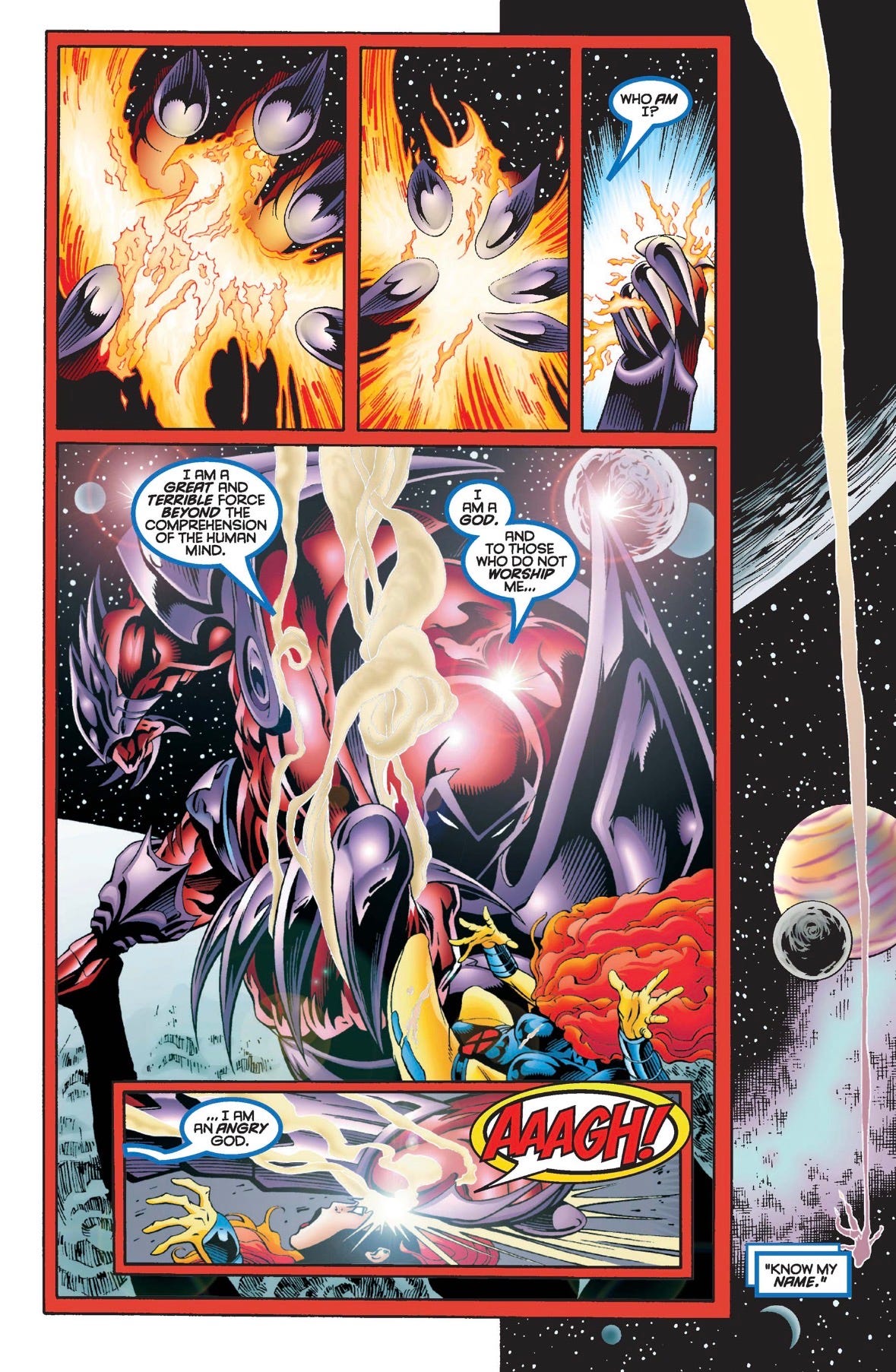
There are some additional allusions to Onslaught in the pages of Cable and Uncanny X-Men, but the first full appearance of Onslaught would take place in X-Men #53 by Mark Waid and Andy Kubert. This is a really good issue where Onslaught appears before Jean Grey on the astral plane. He basically looks like Magneto if Magneto was ten feet tall and wearing armor with lots of sharp edges. This is interesting because Magneto was put into a coma by Xavier back in 1993’s “Fatal Attractions” event as punishment for ripping the adamantium out of Wolverine’s body. There has been a character appearing in the recent comics named Joseph who looks like a significantly de-aged Magneto with amnesia, but it had been unclear up to this point if that was truly Magneto or not. Seeing someone wearing Magneto’s colors and a similar helmet raises further questions. Anyway, Onslaught is basically the Ghost of Christmas Future in this book. He just takes Jean on a little tour across the astral plane to show her just how awful everything is for mutants as well as exposing Xavier as a pervert who wanted to sleep with Jean back when she was his teenage student. Gross! He eventually hits her with some threats and some bars that go hard as hell before departing her mind.
As a kid who was reading these comics at the time, this completely worked on me. I wanted to know who this guy was and what his plans were. Fortunately, I wouldn’t have to wait much longer for an answer. There were additional cameos and allusions to Onslaught in the pages of Uncanny X-Men, Cable, X-Man, and Fantastic Four, but X-Men #54 by Mark Waid and Andy Kubert is where we get the big reveal. After kicking Juggernaut’s ass again, Onslaught drops the veil to show that he is actually Charles Xavier.
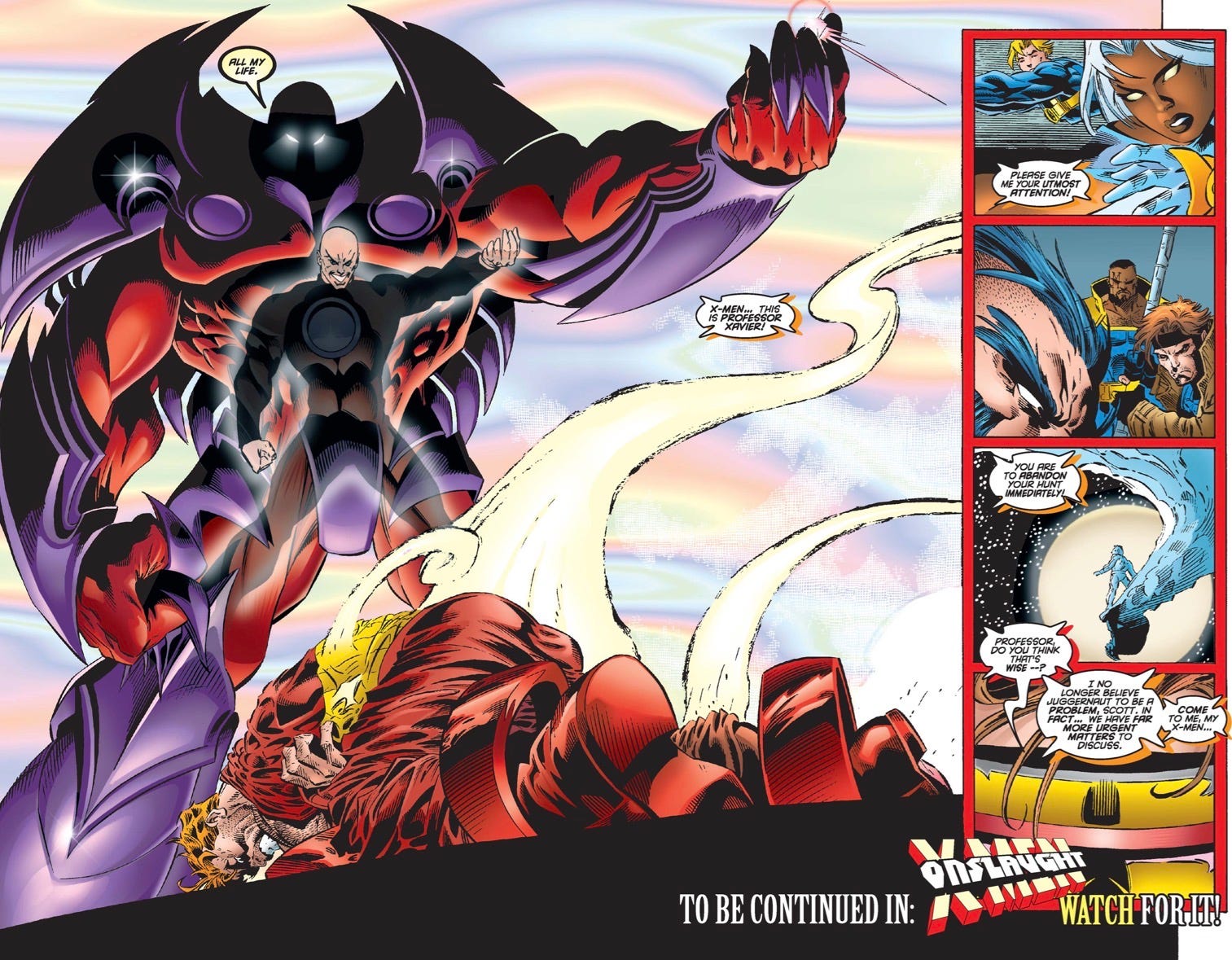
There it is. The whole idea behind this latest event was essentially “Dark Phoenix Saga” for Professor X. I’ll admit that this is a good pitch. Who is the one guy that could potentially cause the most damage by breaking bad? Chuck certainly seems to fit the bill. He’s this incredibly powerful telepath who also serves as a father figure to the most popular superheroes in comics at the time. Want to get fans buying up books? Have that character declare war on the Marvel Universe. It makes a lot of sense, but why would Chuck break bad in the first place?
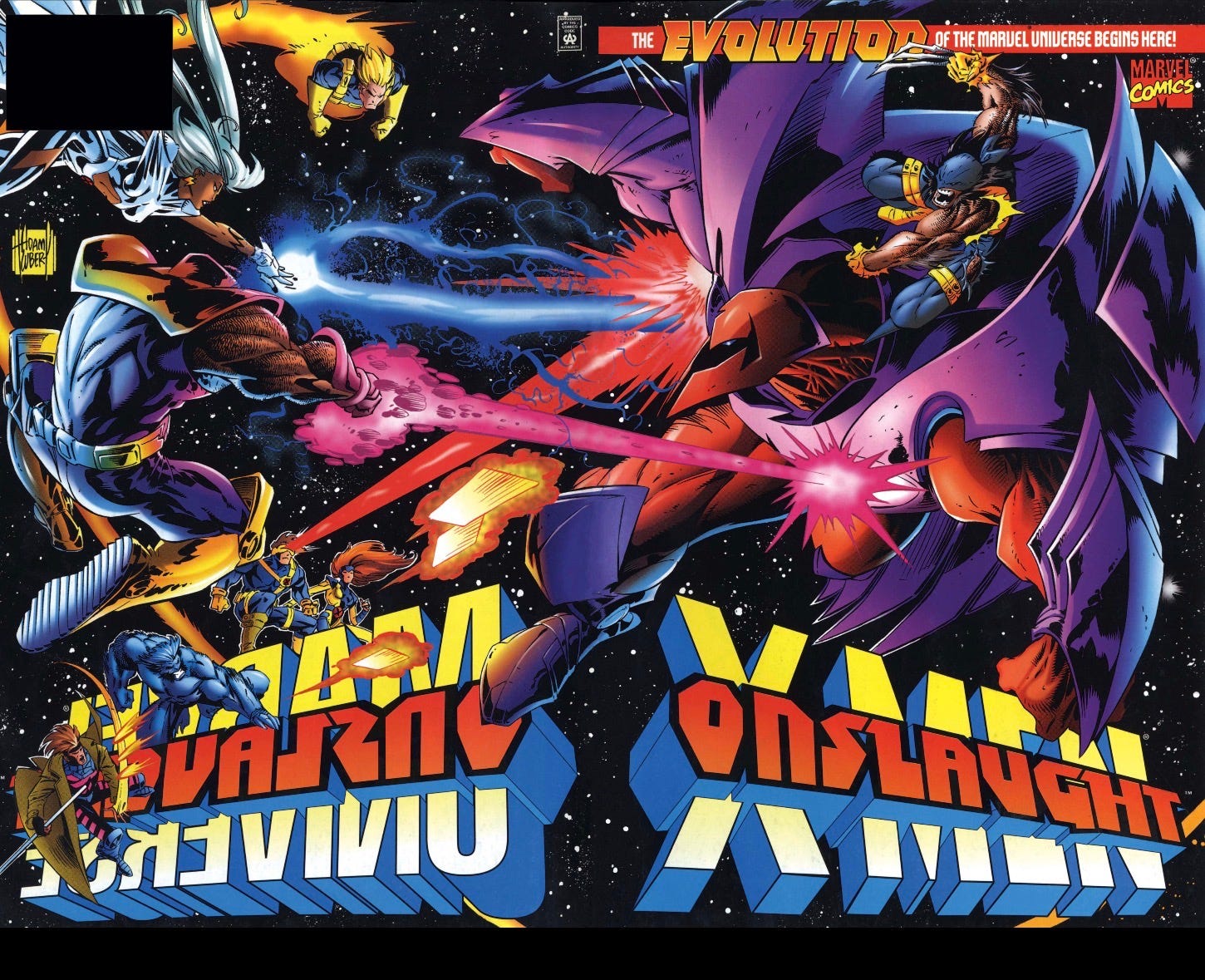
Before we get that answer, we have to check out Onslaught: X-Men #1 by Scott Lobdell, Mark Waid, and Adam Kubert. Yes, we are tagging in the other Kubert brother for this one. Despite the misleading cover, this issue doesn’t have a ton of action. It’s much more about Onslaught trying to recruit the X-Men to his cause.
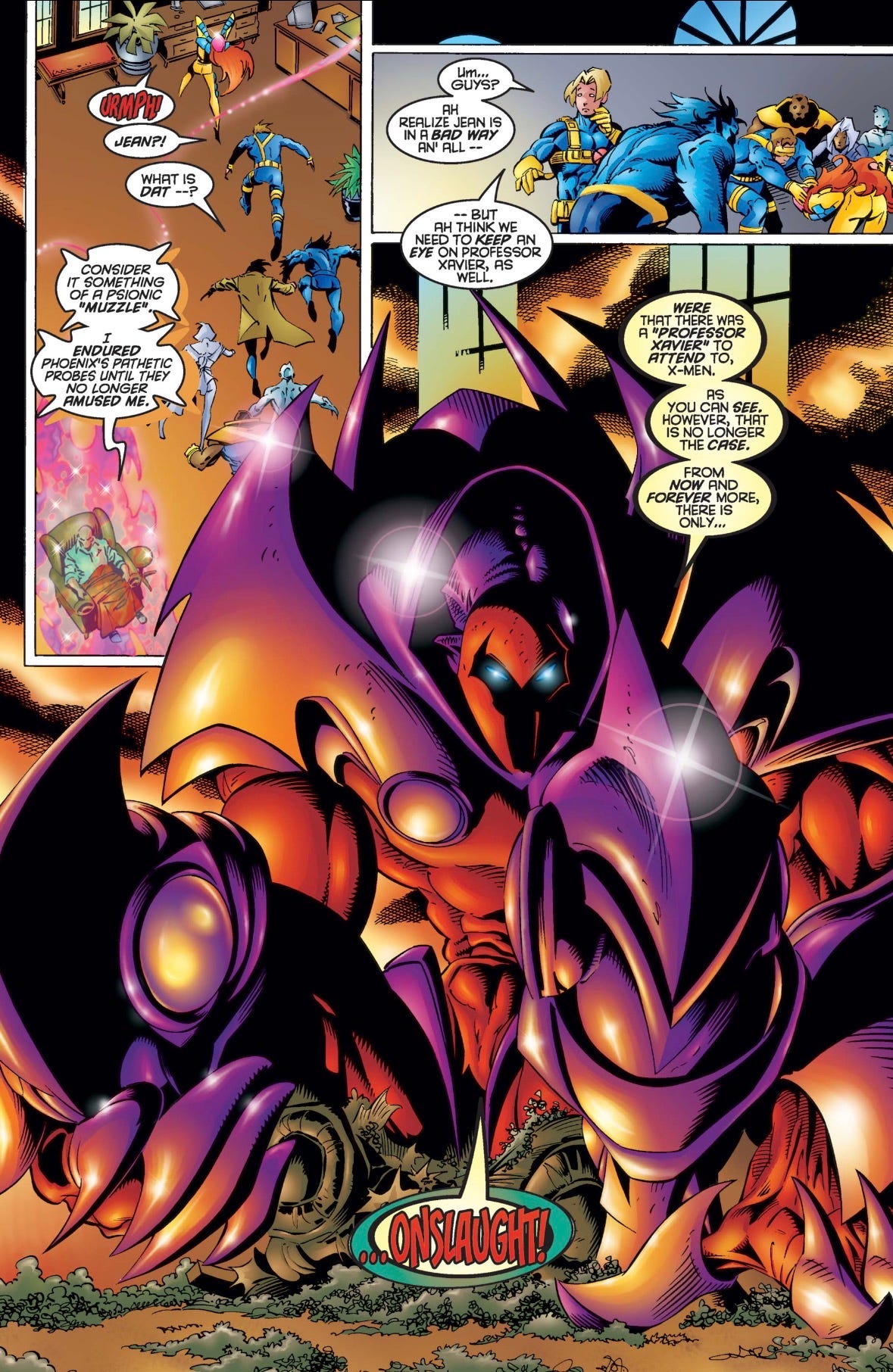
He seems to have abandoned Xavier’s dream of integration, and the X-Men make note of how his rhetoric and appearance seem more like Magneto. This really pisses off Onslaught who insists that he’s an extension of Xavier, but he never fully lashes out at the X-Men for most of the issue. He mostly just screws with their minds and freezes them in place to force them to listen to him. He eventually flees the X-Mansion while he believes the X-Men are subdued in order to astrally project himself into the Baxter Building to chat with Franklin Richards. For those unfamiliar, Franklin is the young son of Reed Richards and Sue Storm of the Fantastic Four. He is a mutant with reality warping powers. Onslaught appears to him as a child going by the name Li’l Charlie (get it?!), and his parents think he just has an imaginary friend. I get why they might think that, but I would not want my young child with the ability to remake reality talking to an imaginary friend. Anyway, the X-Men are able to break free while he’s on his little excursion and find a bunch of files that Xavier has been working on in recent days. He seems to have been focused on two individuals in particular: Franklin Richards and X-Man. I’ve already covered Franklin, so let’s take a quick detour to discuss X-Man. He’s probably the most unfortunately named X-Men character ever. To make a long story short, he is a mutant named Nate Grey created by Jeph Loeb and Steve Skroce for the “Age of Apocalypse” event who made his way into the main universe. He’s basically the “Age of Apocalypse” version of Cable. He was part of Mister Sinister’s eugenics program in that universe the same way that Nathan Summers (Cable) was in the main universe. He’s an insanely powerful character who isn’t hampered by the techno-organic virus like Cable is. Onslaught being so interested in these two probably isn’t good. The issue ultimately concludes when Onslaught returns home, realizes the X-Men aren’t going to join him, and attempts to murder them all in one fell swoop with a massive blast of psionic energy. We’re told in narration that this is the “traitor from within” that Bishop had traveled back in time to stop from killing the X-Men, so he ends up absorbing the blast himself to theoretically prevent the terrible future he hails from. He somehow survives this, and an annoyed Onslaught departs having expended too much energy. We also get a little teaser of an ending that Onslaught intends to use Sentinels for something down the line. I honestly think this is a pretty cool issue with some incredible Adam Kubert artwork. I’m a fan of both of the Kubert brothers, so I’m happy that they’ll both play huge roles in this event.
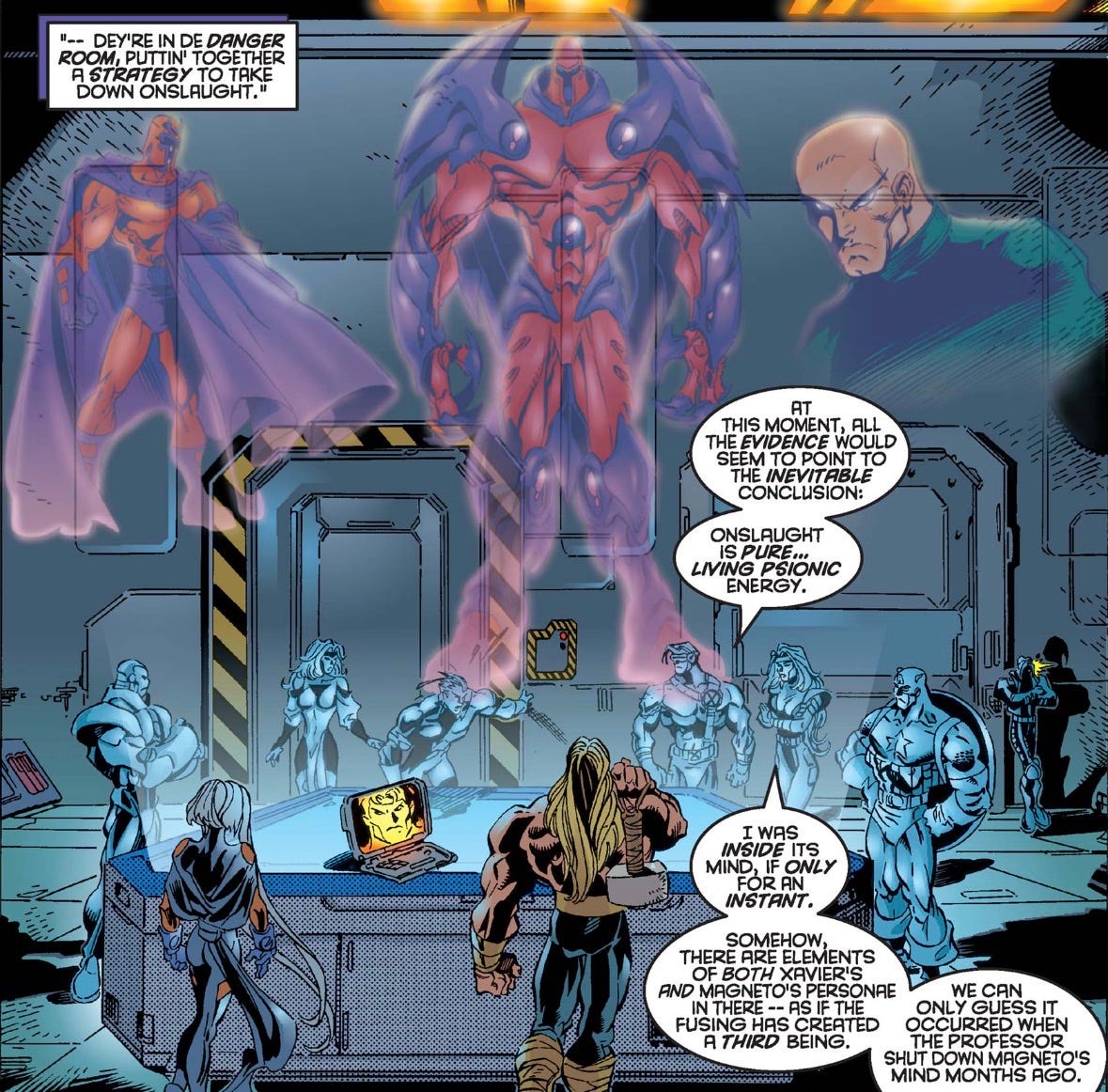
The explanation for why Xavier broke bad is kind of explained in Uncanny X-Men #335 by Scott Lobdell and Joe Madureira. More detail is provided later, but the gist of it is this: when Xavier shut down Magneto’s brain at the end of the “Fatal Attractions” event, he basically accidentally absorbed Magneto’s id which merged with Xavier’s id and created a psionic being that embodied the worst aspects of both men. Clearly Lobdell is a fan of Freud. I think it’s a good enough explanation, but it does automatically build in an escape hatch should editorial decide they want to completely absolve Xavier of responsibility for any of Onslaught’s actions (like Jean Grey with Dark Phoenix or Hal Jordan with Parallax). Spoiler alert: they won’t even wait for the end of the event to do so.
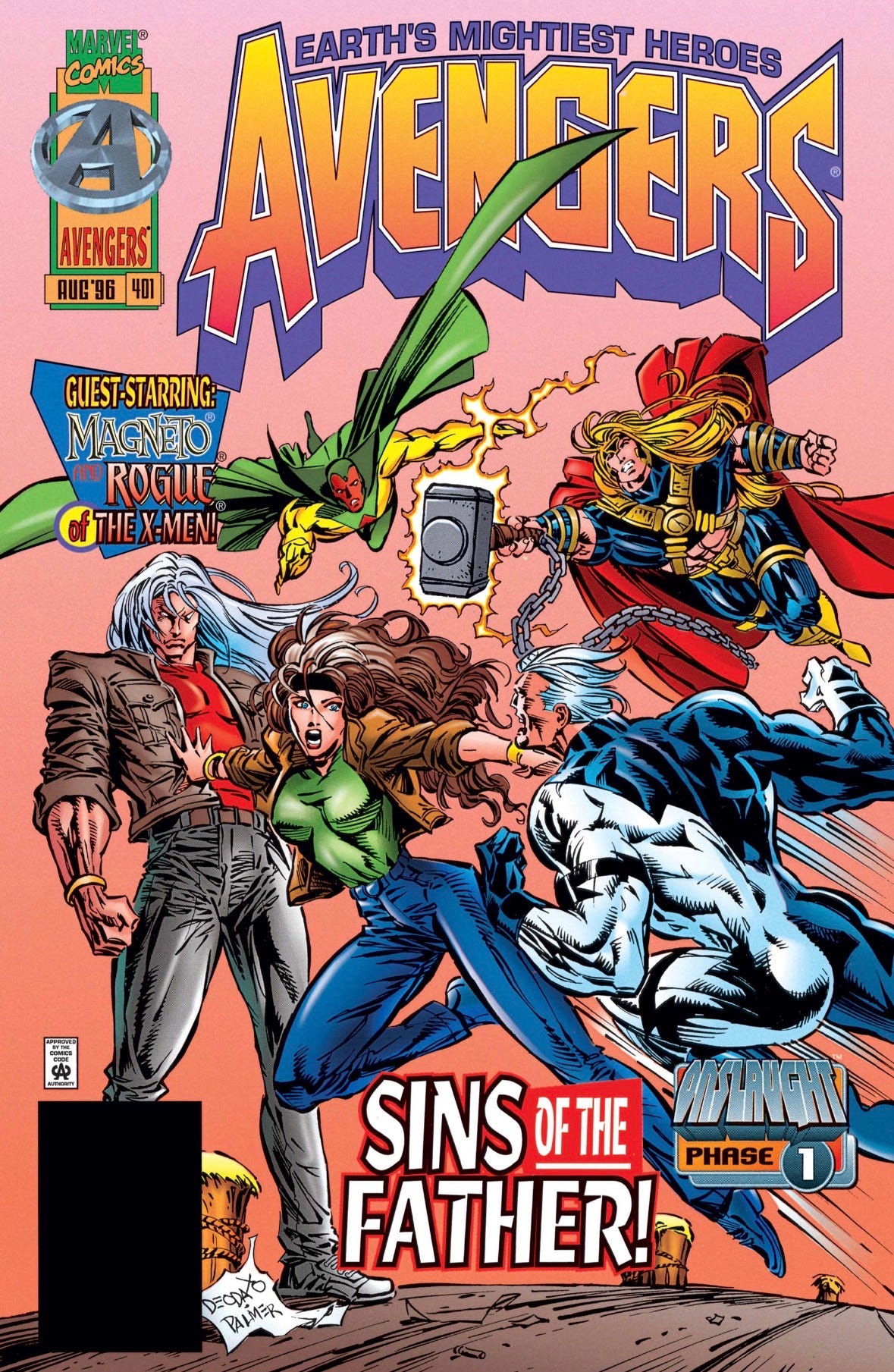
With Onslaught now fully established as the big bad for this event, it’s now time for this crisis to spill over into even more titles. The story expands into Avengers #401 by Mark Waid and Mike Deodato, Fantastic Four #415 by Tom DeFalco and Carlos Pacheco, Cable #34 by Jeph Loeb and Ian Churchill, and Incredible Hulk #444 by Peter David and Angel Medina. Avengers #401 is mostly about Quicksilver running up on Joseph of the X-Men because he thinks he’s his de-aged dad, and he blames him for all of this Onslaught nonsense. Fantastic Four #415 is about Onslaught fighting the Fantastic Four and kidnapping Franklin. Cable #34 and Incredible Hulk #444 are about Cable fighting Hulk who is being mind controlled by Onslaught. The Cable issue is the highlight for me thanks mostly to Churchill’s incredible artwork. You can hear my more in depth thoughts on it and the Incredible Hulk issue on this episode of the Gamma Charge podcast if you’re so inclined.
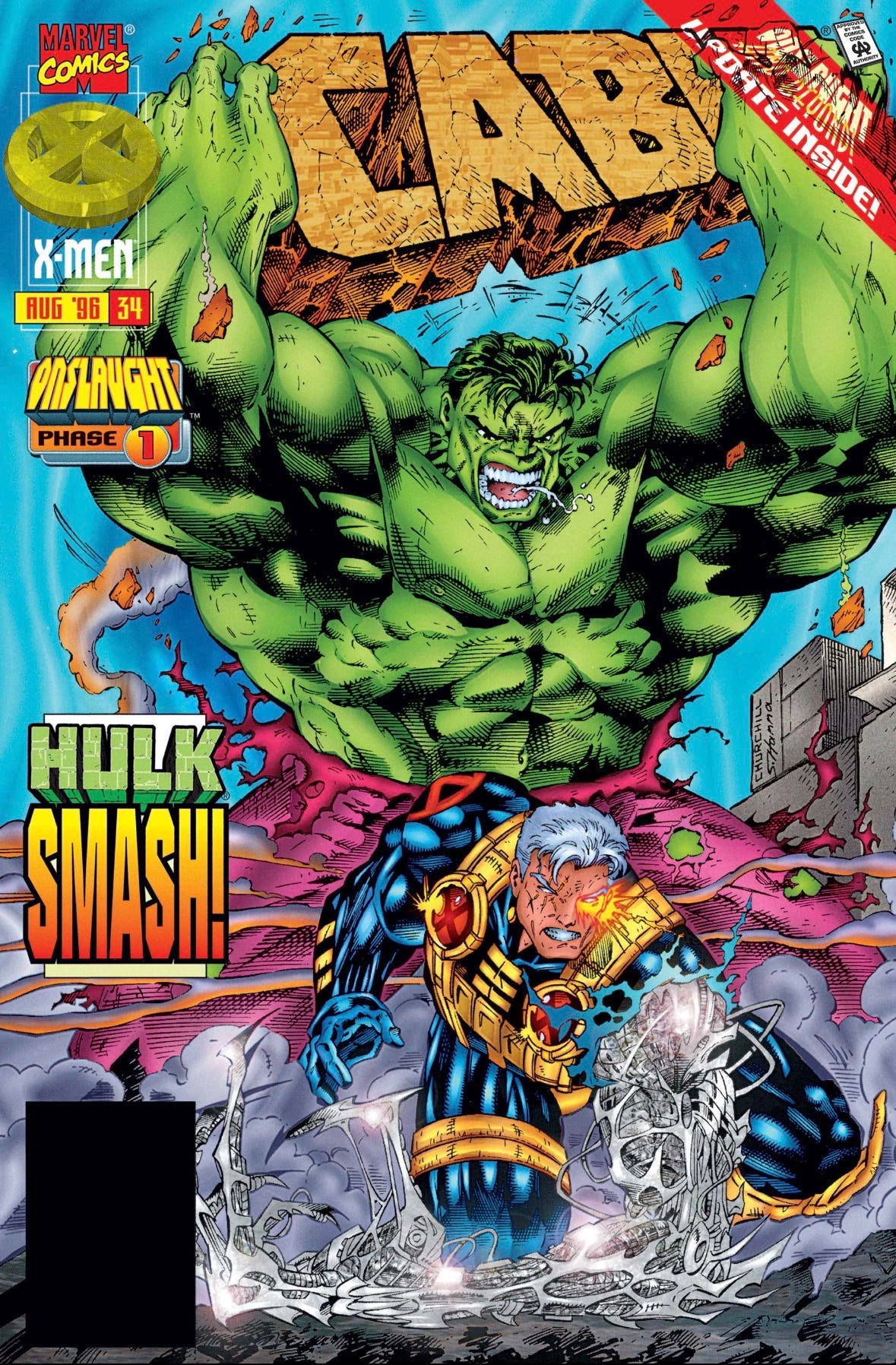
The main thing I want to highlight is that I had never read an issue of Avengers, Fantastic Four, or Incredible Hulk in my life before this event. The only comics I was reading in 1996 were either part of the X-Men or Spider-Man lines of comics, and sales numbers at the time indicate I wasn’t the only one. I also want to make clear that the number of titles that made up the X-Men and Spider-Man lines vastly outnumbered the other titles Marvel was putting out by the time Onslaught showed up. The titles in the X-Men line included books like Uncanny X-Men, X-Men, X-Force, X-Factor, Excalibur, Wolverine, Cable, and X-Man. The titles in the Spider-Man line included Amazing Spider-Man, Spectacular Spider-Man, Spider-Man, Sensational Spider-Man, Green Goblin, and a few different Venom limited series. That’s to say nothing of the many one-shots, minis, and crossovers. Say what you will about the event overall, but the first phase of this crossover successfully got my eyes on comics I never would have read otherwise. I suspect I’m not the only one, and this would pay dividends later.
I’ll end things here for now. This is the end of “Onslaught: Phase One” before transitioning to “Onslaught: Impact One.” You can follow along with Marvel’s reading guide on Marvel Unlimited (even though they mess it up and incorrectly recommend you read Uncanny X-Men #335 before Onslaught: X-Men #1). Next week we’ll see how other heroes and teams get pulled into this event like X-Factor, X-Force, and Spider-Man.
I started reading Marvel comics right after Age of Apocalypse, and Onslaught was MY first big multipart crossover event. I really enjoyed the X-Men: Onslaught special and Madureira drawing the Avengers. But even back then, I noticed how Onslaught had almost every opportunity to kill the heroes and was just like… “nah, maybe next time.”