
Onslaught: The Event that Changed Marvel Comics Forever Part 4
The Onslaught ends, and the heroes are reborn

All good things must come to an end, and that includes this far too long four-part series on Onslaught in honor of his reign of terror turning thirty this year. I mentioned last week that I was starting to feel event fatigue, so it’s a good thing this is the final chapter. Kinda. Anyway, I’m only going to cover the comics tied directly to the event and the subsequent “Heroes Reborn” titles here. I’m not going to cover the many epilogues to the event in the various X-Men books that followed. Just know that there were many. Let’s dive in.
Onslaught: The Final Chapter
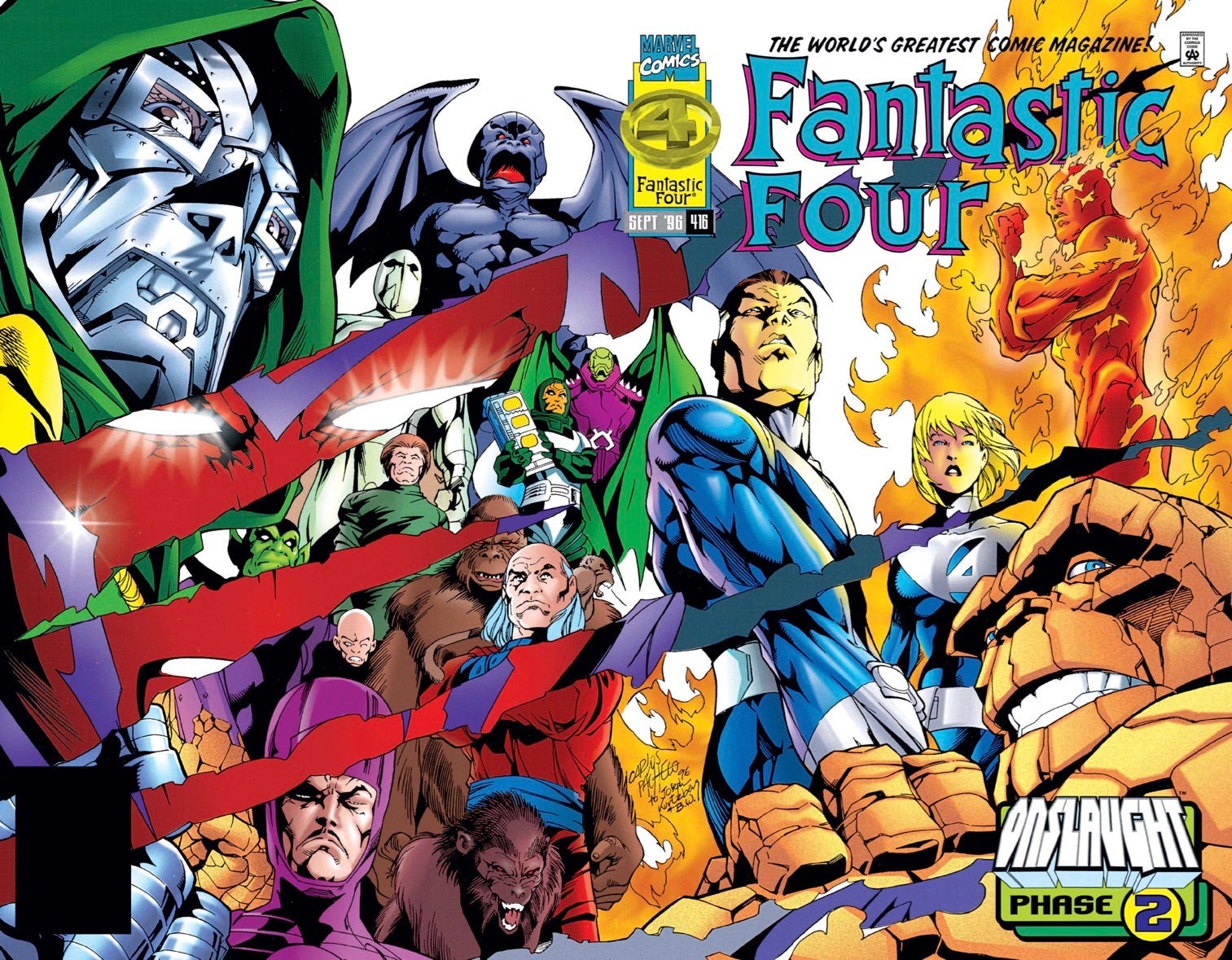
Let’s start with the final issue of Fantastic Four before its relaunch. That would be Fantastic Four #416 by Tom DeFalco and Carlos Pacheco. Fantastic Four is the comic that birthed the Marvel Universe as we know it, so it’s only right that it be the first comic we read as part of this final chapter of the Onslaught event. This issue features multiple allies (and a couple adversaries) of Marvel’s First Family coming to join them as they prepare to rescue Franklin. That includes the Inhumans, Black Panther, She-Hulk, Namor, and even Doctor Doom. Unfortunately, they end up coming under attack from basically every villain they’ve ever had. Mole Man, Wizard, Kang, Red Ghost, Psycho-Man, Annihilus, and many more all descend upon our heroes seemingly out of nowhere. As you might have guessed, these are all just constructs created by Onslaught to harass our heroes. Reed Richards creates a device to cause them to dissipate, and the Fantastic Fifty (at least it seems like that many heroes) get ready for their final battle with Onslaught.
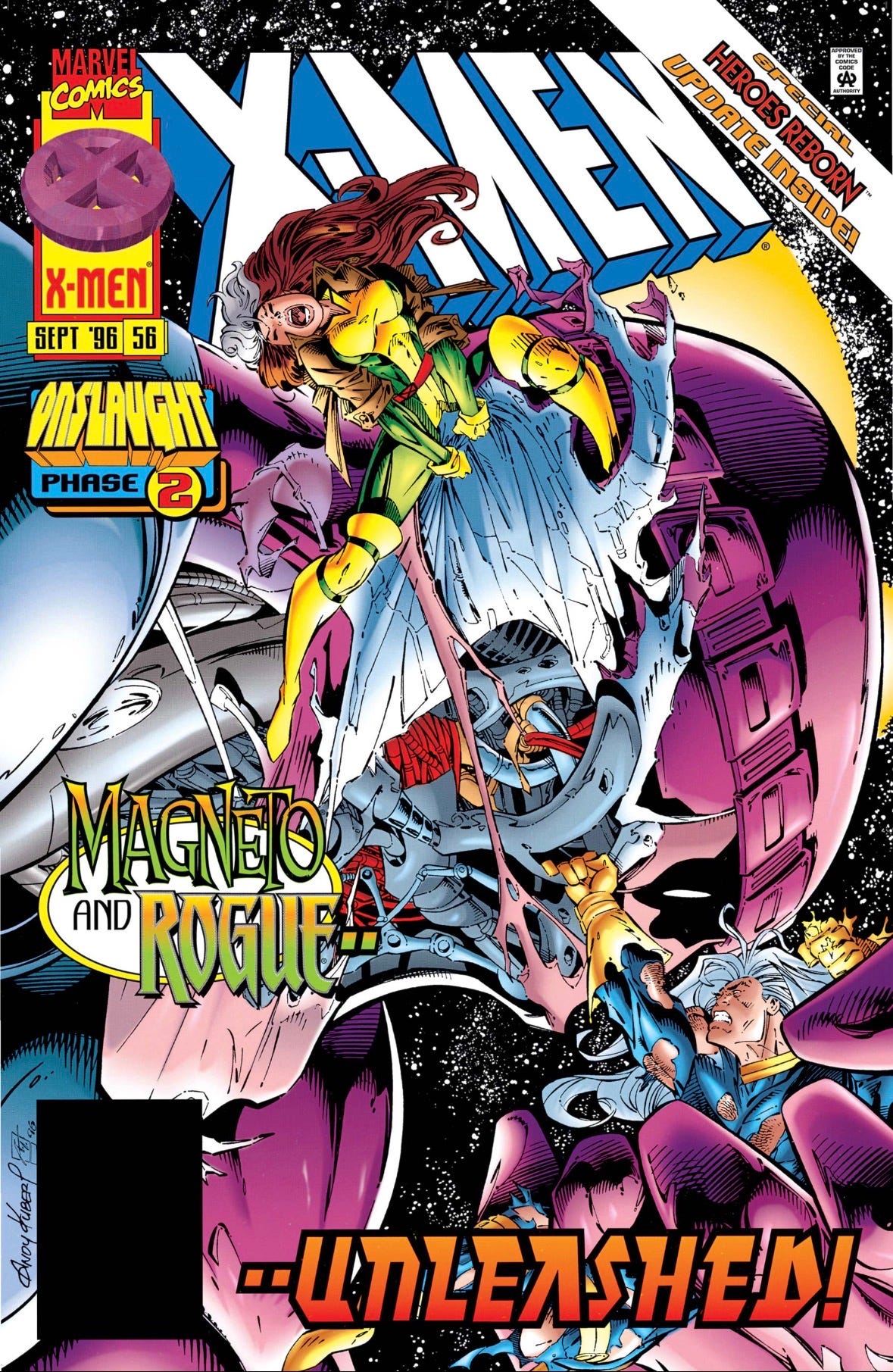
The last story we get before the climactic battle takes place in X-Men #56 by Scott Lobdell, Mark Waid, and Andy Kubert. The cover leads us to believe that this is an issue focused on Magneto and Rogue kicking ass, but that is a bit misleading. First of all, this is Joseph (#NotMyMagneto) and Rogue. Secondly, this is a huge ensemble cast. The issue opens with Joseph and Rogue fighting Sentinels, but it isn’t long before Doctor Doom, the Avengers, Professor Xavier, the Fantastic Four, Cyclops, and Jean Grey all join them to prepare for the final confrontation with Onslaught. Speaking of Onslaught, we see him with both X-Man and Franklin Richards in his clutches.
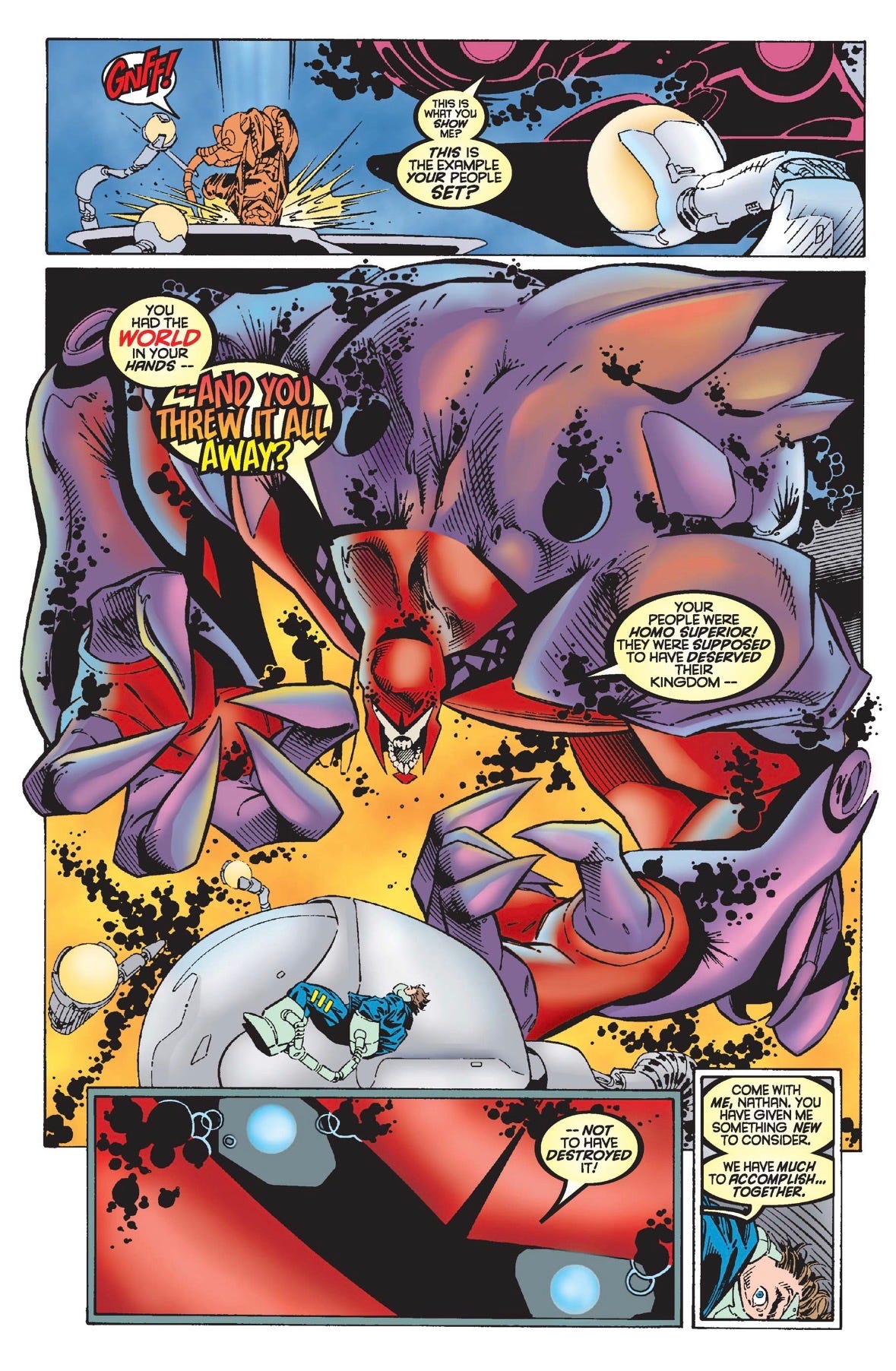
He drills deep into X-Man’s mind in order to understand what the “Age of Apocalypse” universe was like, and he is bitterly disappointed with what he finds. Onslaught had planned to recreate that universe here under the assumption that a world where mutants were in charge would be superior to one where humans are. Seeing all of the violence and death that took place with Apocalypse in charge convinces him that the best move would be wiping out both species entirely. With Franklin and X-Man both under his control, he might just have the power to do so. The issue ends with Xavier meeting with Onslaught by himself to try and talk some sense into him. Unsurprisingly, this fails miserably. This finally sets up the grand finale.
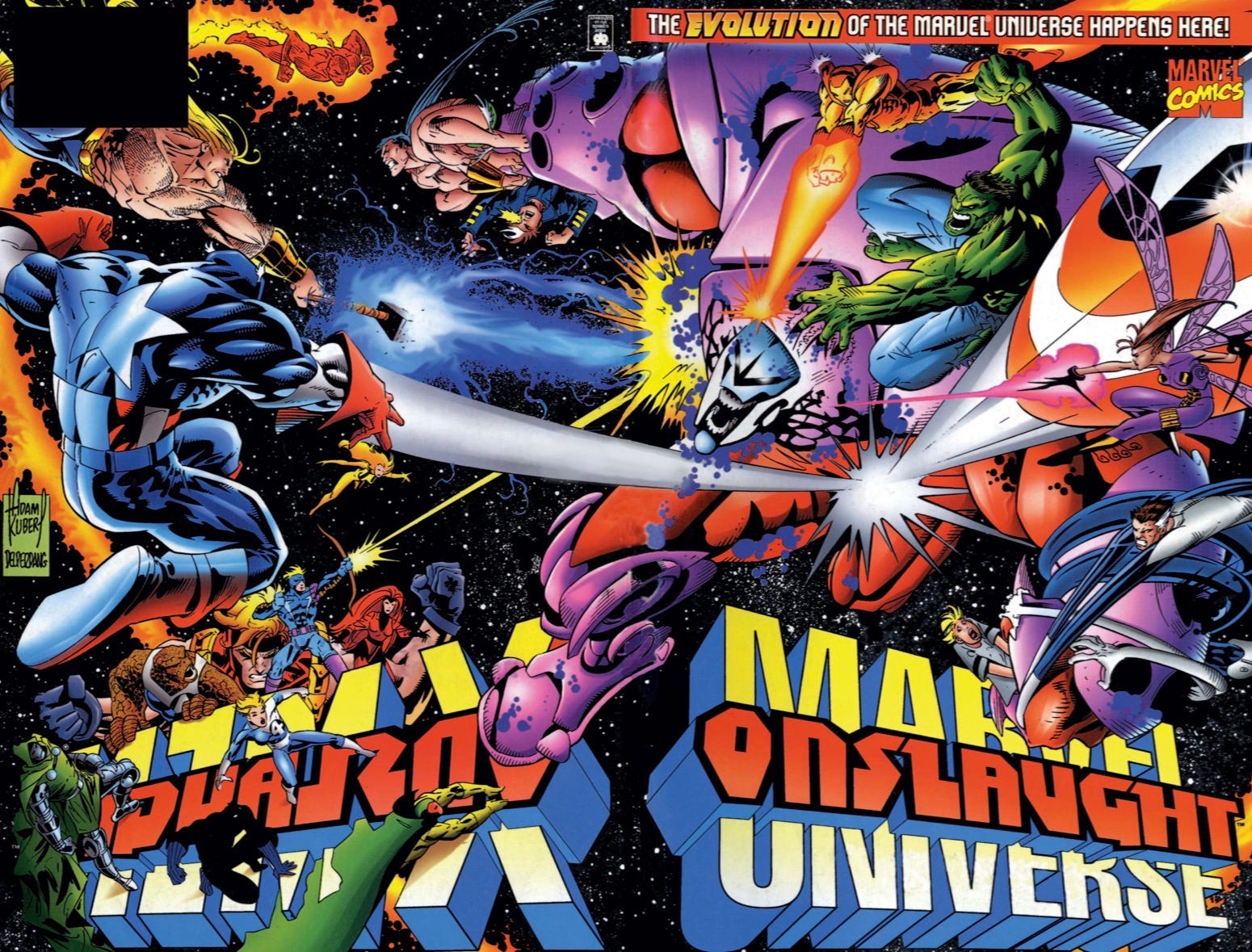
Onslaught: Marvel Universe #1 by Scott Lobdell, Mark Waid, Adam Kubert, and Joe Bennett is the double-sized final chapter of this massive event. I’m going to be totally honest here: there is very little story in this issue. It’s almost nothing but huge fights and splash pages showing off characters in heroic poses, and I could not be happier about it. This issue basically revolves around the X-Men, Avengers, Fantastic Four, Hulk, Namor, and Doctor Doom all showing up in Manhattan to fight Onslaught while Uatu the Watcher watches (that’s kind of his thing). You might notice one superhero conspicuously absent from this lineup: Spider-Man. We last saw him and Peter Parker fighting Sentinels before saying they were heading out to join the fight against Onslaught, so where are they? I’ll explain that in a bit.
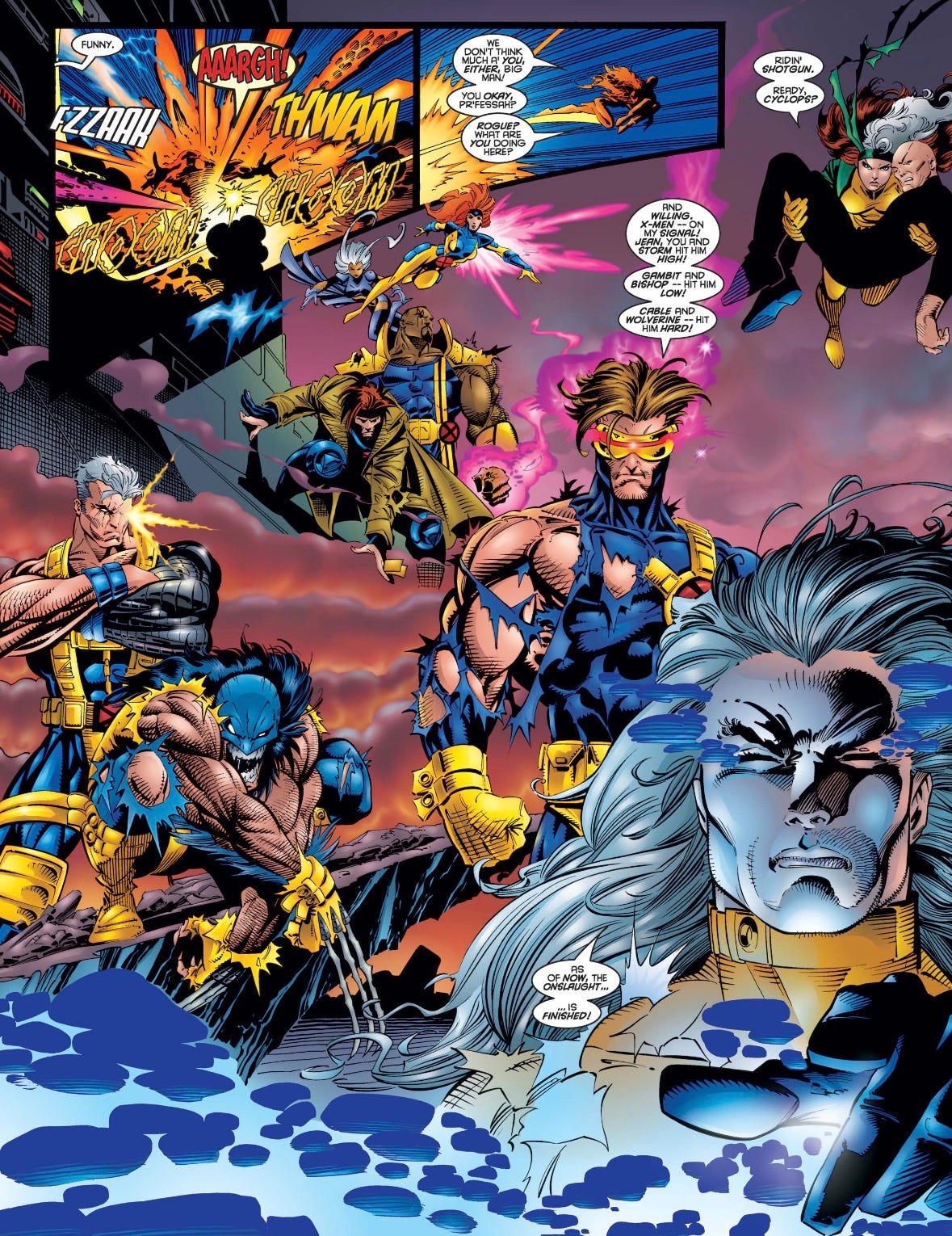
The X-Men show up first because this is primarily their event. They get Xavier away from Onslaught, and then they let the fight commence. By that I mean Onslaught immediately mops the floor with them. It literally only takes one page from him to basically defeat them. Fortunately, they get some reinforcements.
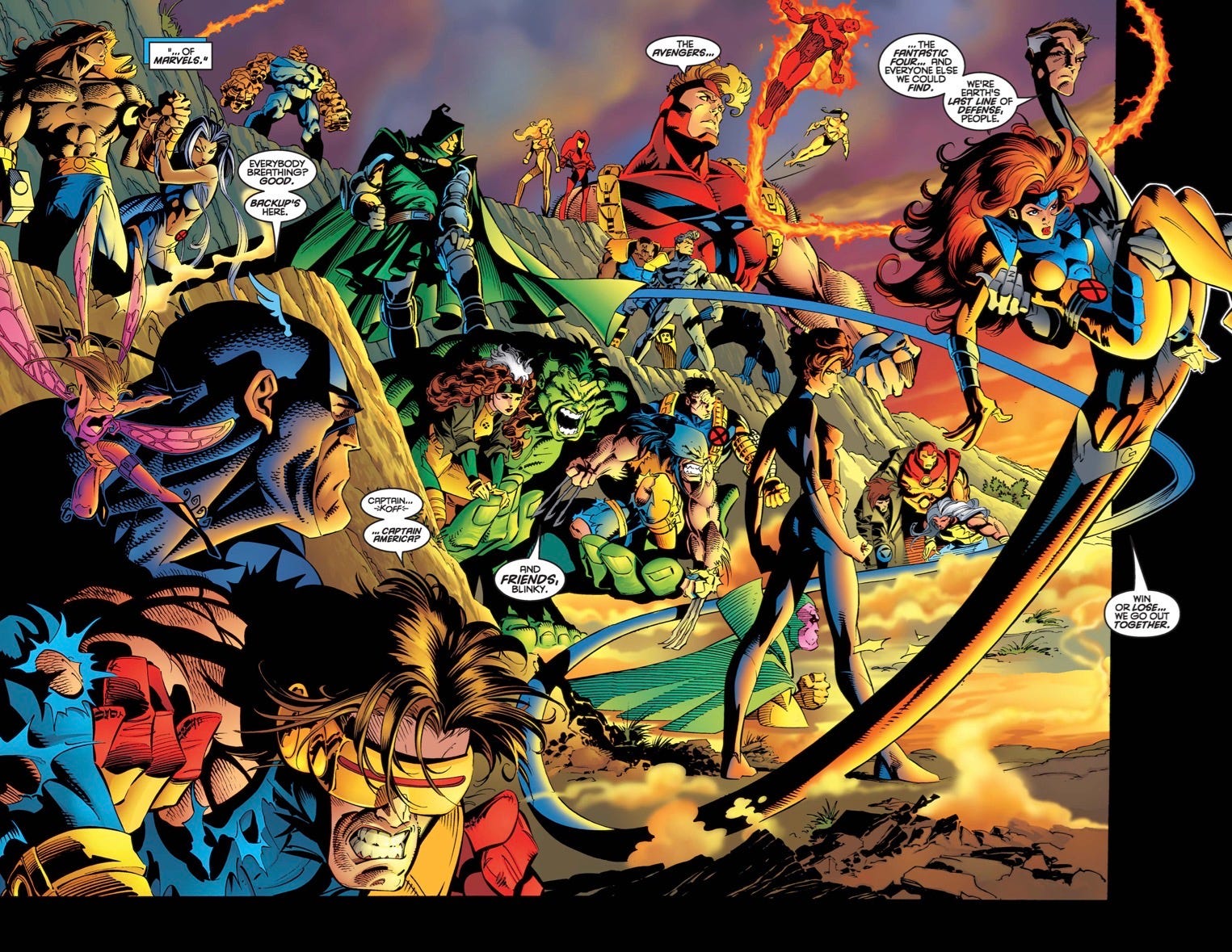
The Avengers, Fantastic Four, Hulk, Namor, and Doctor Doom show up to rescue their mutant brethren. It doesn’t seem to help much. Onslaught starts thrashing them as well, so they all start taking cover. It provides an opportunity for Xavier and Joseph to have a brief chat. It would feel more important if Joseph actually was an amnesiac Magneto, but knowing he isn’t kind of sucks the energy out of it. I can’t really blame Lobdell and Waid for that. They wouldn’t have been privy to that retcon yet. Meanwhile, the various heroes try to come up with ways to attack Onslaught. Most of them just kind of punch at him to no avail, but Doom hatches a plan that involves Vision phasing over Rogue and having both of them fly at him at full speed. It looks cool, but it doesn’t seem to do a whole lot of damage. It does apparently weaken his defenses ever so slightly, so it opens up a tiny window to potentially inflict some punishment. This leads to my favorite moment of the issue. Hulk asks Jean Grey to completely turn off the Banner portion of his brain so that he goes completely savage and deliver a ferocious attack on Onslaught without mercy. Might as well go for broke, right? So Jean does exactly that!
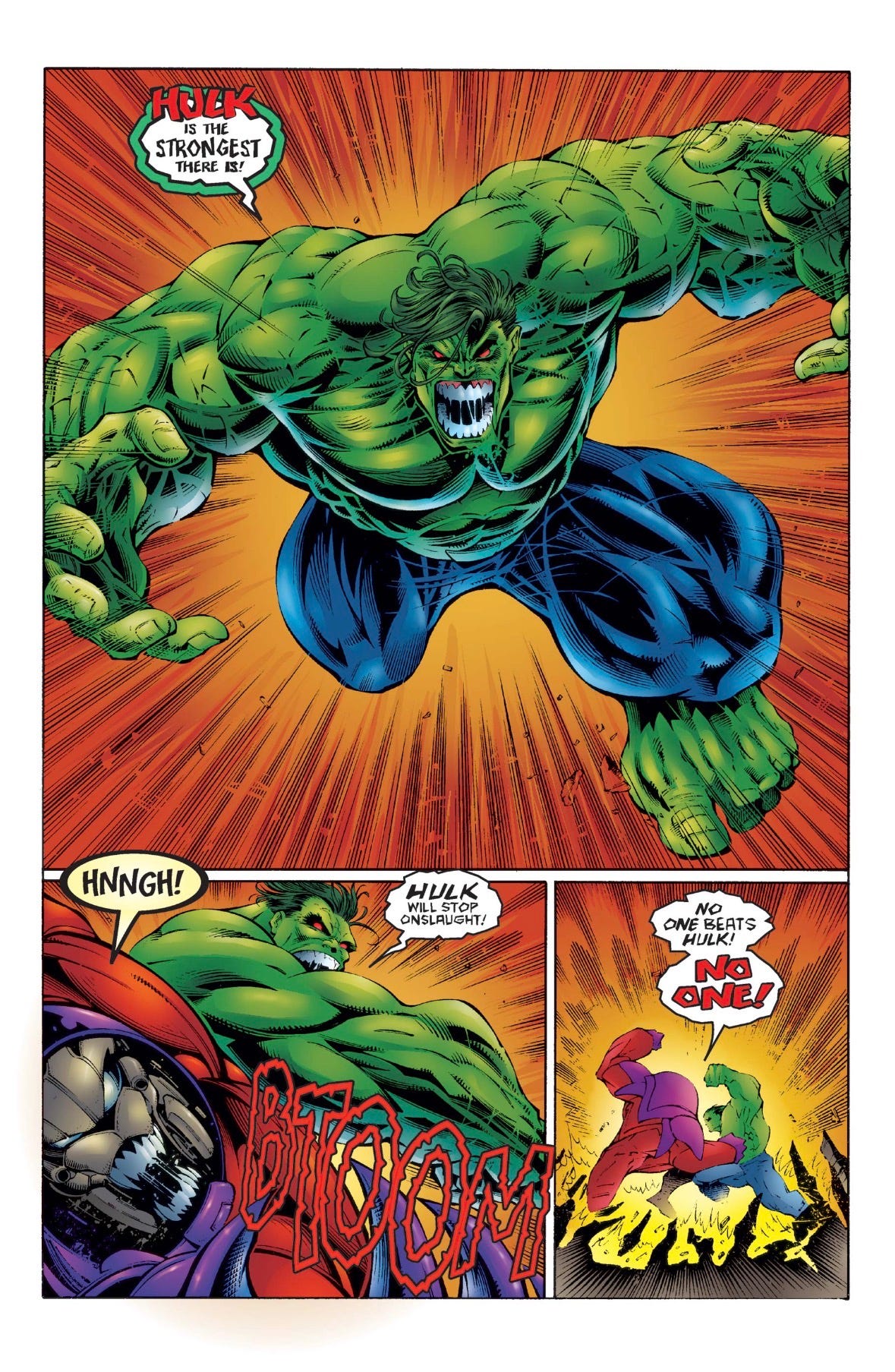
It results in one of the most metal comic book fights I’ve ever seen. Hulk and Onslaught start punching each other so hard that it creates shockwaves so intense that the other heroes (as well as plenty of debris) are being blown back like they’re in a hurricane. Hulk ends up punching Onslaught so hard that it shatters his armored exoskeleton, but it also causes Hulk and Banner to split into two separate physical individuals. The explanation (provided by Gambit of all people) is that Hulk punched him so hard that it altered reality. It’s very silly, but I love it. I also want to point out that this whole Onslaught saga started with him punching Juggernaut from Canada to New Jersey, so I think we can definitively say that Hulk is the strongest one there is.
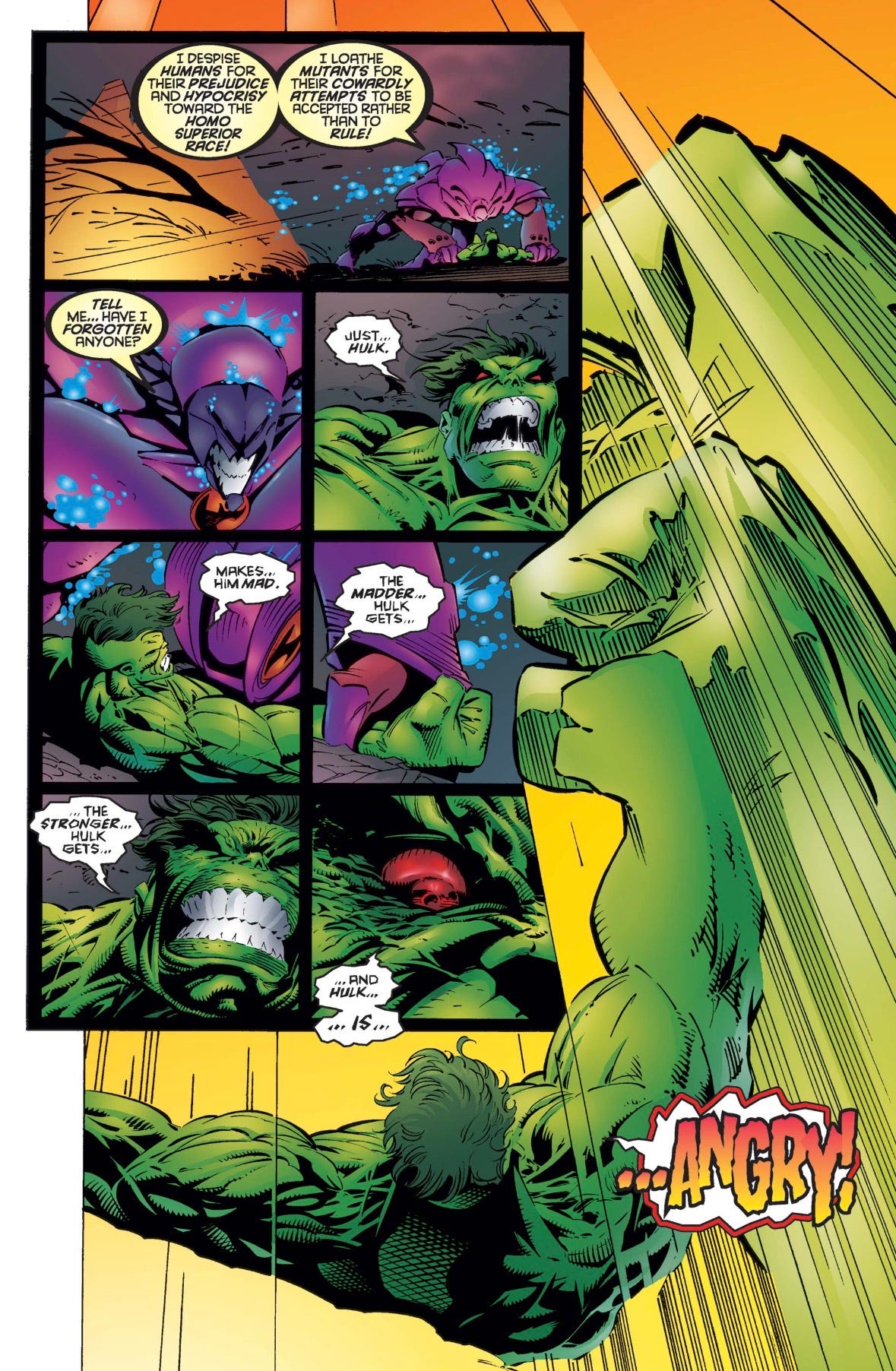
Unfortunately, this does not actually defeat Onslaught. It’s revealed that Onslaught is now a being of pure psionic energy with no corporeal body. It looks like there is no way to defeat him. The good guys have lost. Just kidding! Thor decides to just fly right into the mass of psionic energy to try and contain it within his own god bod. It does seem to bother Onslaught, but it isn’t enough. It does give the heroes an idea. They will all jump into Onslaught’s psionic energy to try and contain him!
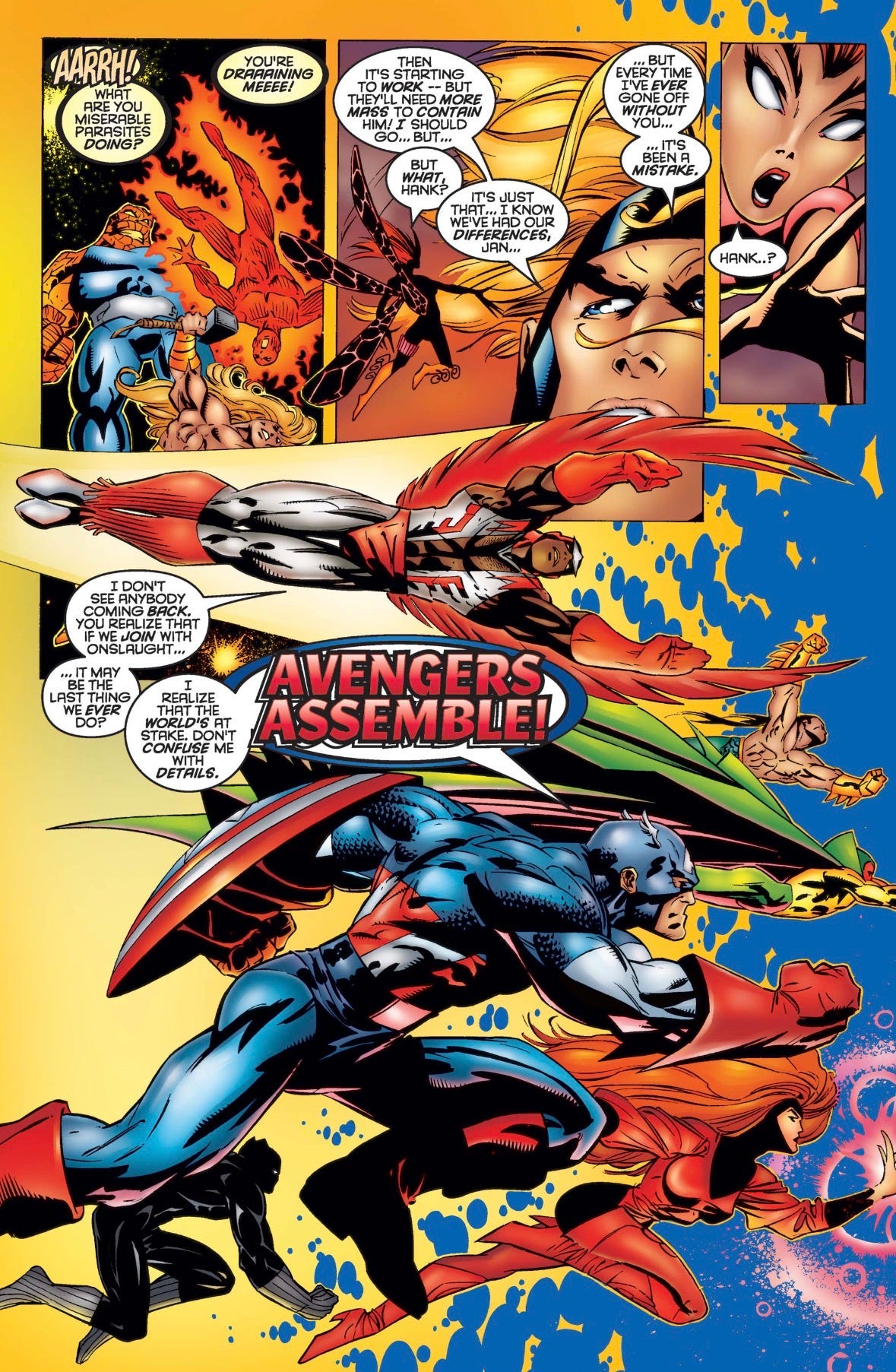
The Avengers, Thing, Human Torch, and Namor dive in with no hesitation. The X-Men start to do the same, but Reed tells them that Onslaught would actually get stronger if mutants enter the psionic energy since he started off as a mutant. Reed probably should have said something sooner because Namor is a mutant, and he already flew in there! Not sure how editorial forgot that considering his solo series that had just concluded in 1995 proudly declared on every cover that he was “MARVEL’S FIRST AND MIGHTIEST MUTANT.” Whoopsie! Anyway, the plan then becomes for all of the non-mutant heroes on the scene to enter Onslaught’s psionic energy field so that the X-Men will have a physical presence to attack and kill. You can probably see where this is going. Doom is lurking in the background as this is happening so he can use some sort of device to steal Onslaught’s power or something because he’s Doom, but Hawkeye shoots the device with an arrow and Iron Man flies him into the psionic energy field with the heroes. Take that, Victor! Reed and Sue jump in once Doom has been pulled in, and they instruct the X-Men to attack once they’re inside. It seems like they’ll be the last ones in, but Bruce Banner wakes up and jumps in as well at the last second. Hulk, however, does not. The X-Men hit them with everything they have, and Onslaught is destroyed along with all of the heroes. The only thing remaining is a weird blue ball that Franklin takes with him afterwards.
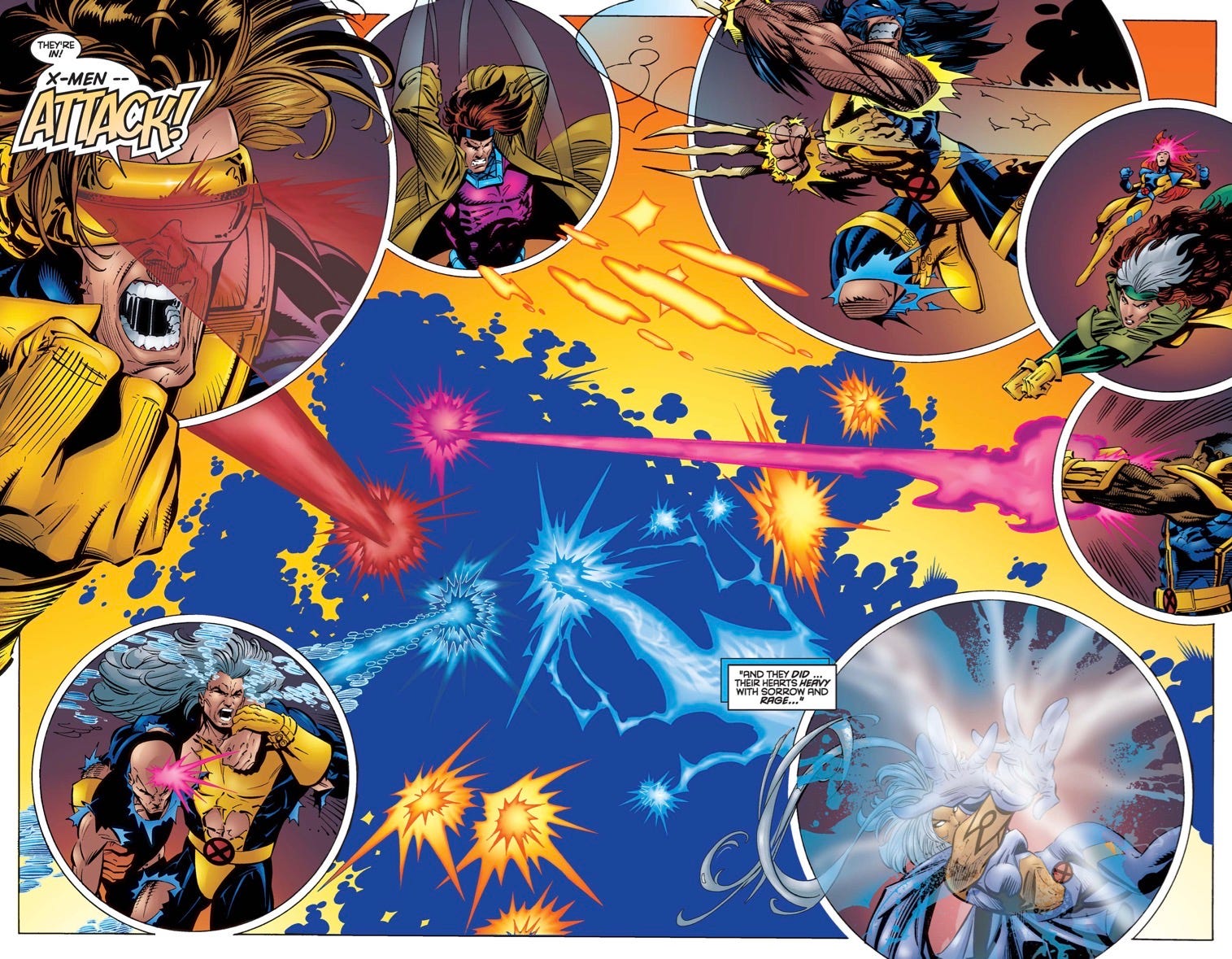
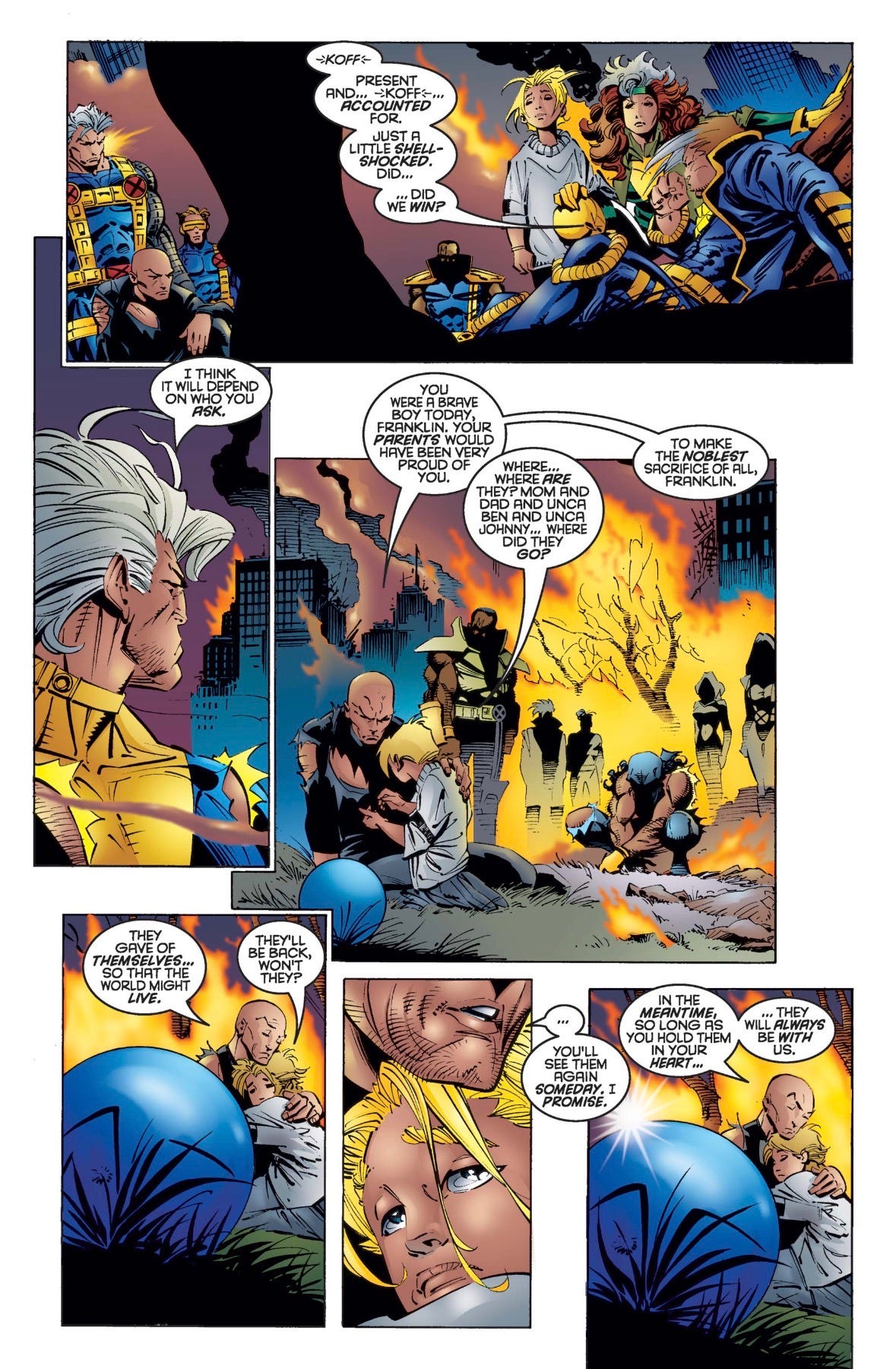
If you’re keeping score at home, the Avengers, Fantastic Four, Namor, Doctor Doom, and Bruce Banner are all dead. The X-Men and Hulk are both alive, and Spider-Man is also fine since he never showed up to the fight. I guess he and Peter got lost somehow. What this means from a publishing perspective is that all of the X-Men and Spider-Man titles can continue as normal as well as Incredible Hulk since those characters haven’t gone anywhere. As I mentioned when I started this series, the X-Men and Spider-Man titles were Marvel’s bestsellers at this point. I honestly don’t know if the motivation behind keeping Incredible Hulk going was due to sales, pop culture relevance, or Peter David fighting like hell to keep him and not let Jim Lee or Rob Liefeld snatch him all for themselves. I’d like to think it was all three. Regardless, all of the other heroes present have been whisked away to a pocket dimension in the blue ball Franklin Richards created with his reality warping powers.
What that means from a publishing standpoint is that they’ve been farmed out to a pair of independently owned studios in an attempt to boost sales. Those studios were Jim Lee’s WildStorm Productions and Rob Liefeld’s Extreme Studios. Jim Lee’s WildStorm would publish Fantastic Four and Iron Man, and Rob Liefeld’s Extreme Studios would publish Avengers and Captain America. I’m not going to cover all thirteen issues from each of these relaunches, but I figured I’d at least discuss the first issues of each series.
Enter: Heroes Reborn
Fantastic Four #1 by Jim Lee and Brandon Choi
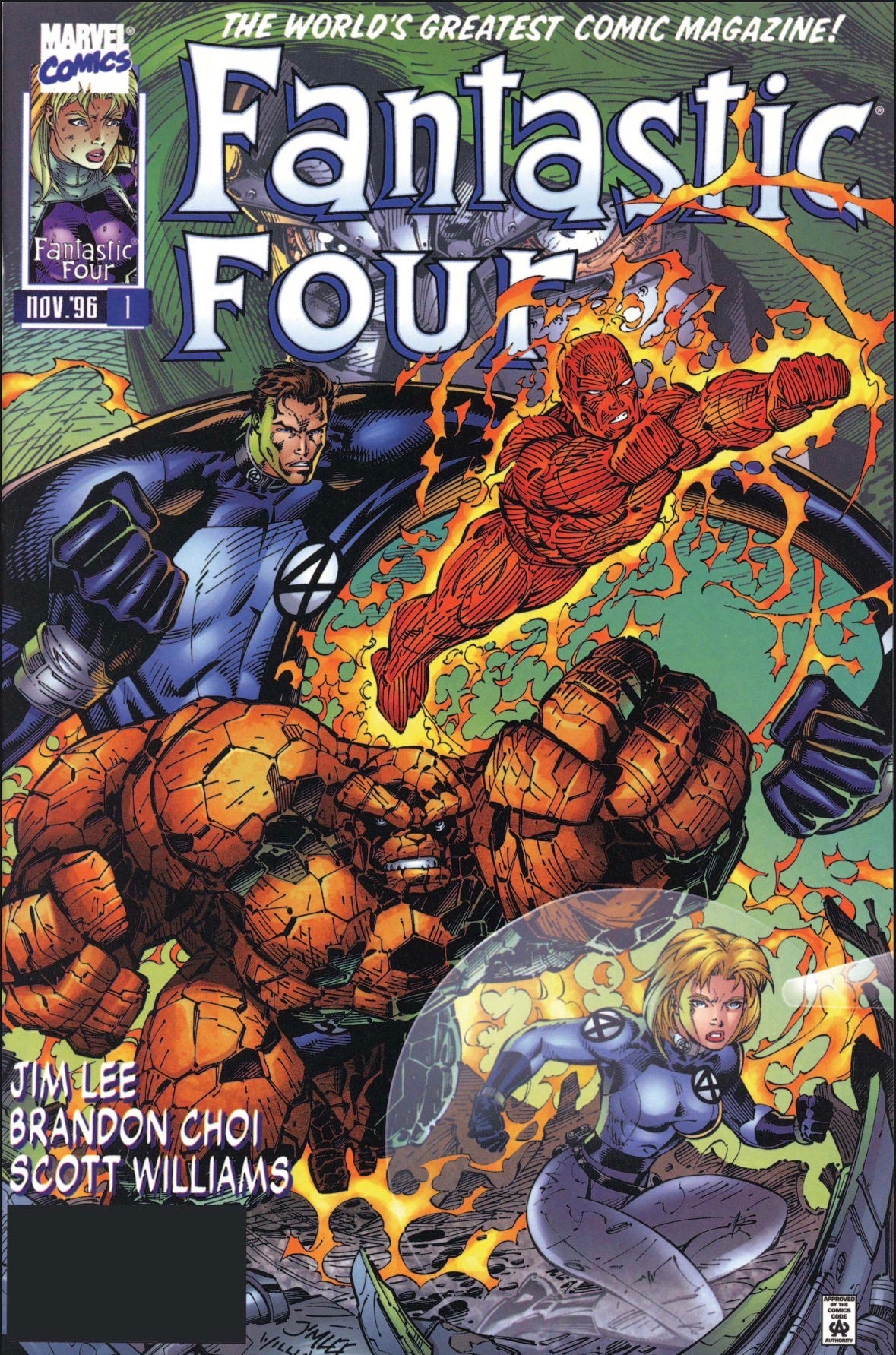
Let’s start with Marvel’s First Family. I’ve mentioned previously that I was not reading Fantastic Four as a kid in the 1990s. I knew the basics about them, but I never picked an issue off of a spinner rack prior to Onslaught showing up. As an adult, I’ve gained a huge appreciation for these characters. I’ve tried to find as many issues of the original Stan Lee and Jack Kirby run as possible. Having gained that appreciation, I now think that nailing the relaunch of this series was the most important of all four books of the Heroes Reborn experiment. So how does Jim Lee do with the first issue?
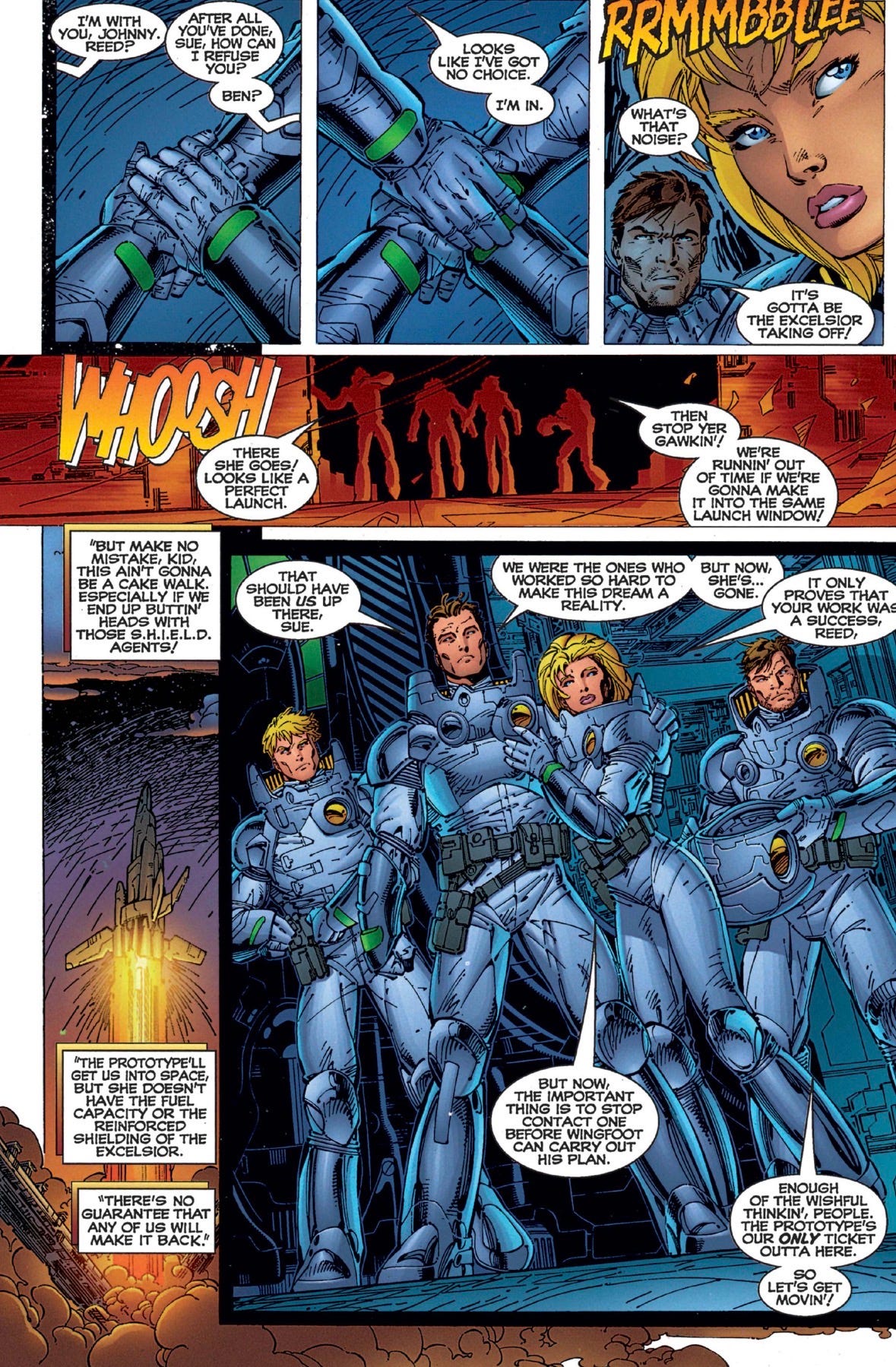
I should start by clarifying the creative team on this book. Lee is credited with plotting and illustrating the book, and Brandon Choi is credited with scripting. I take this to mean that the basic story beats are handled by Lee while Choi writes the dialogue. The big selling point for this book was obviously Jim Lee’s art. He was one of the most popular artists of the decade, so seeing his take on Kirby’s classic character designs and action is what people came to see. Unfortunately, this first issue doesn’t seem to really play to Lee’s strengths. It’s a lot of people in suits talking to each other for the first half of the issue. I understand that there’s a good deal of setup happening in this first issue, but I would expect it to still be visually interesting. This is basically a remake of Fantastic Four #1 from 1961, but it really takes a while to get to the action whereas the original opened with some action and adventure before flashbacks showed how our heroes got their powers.
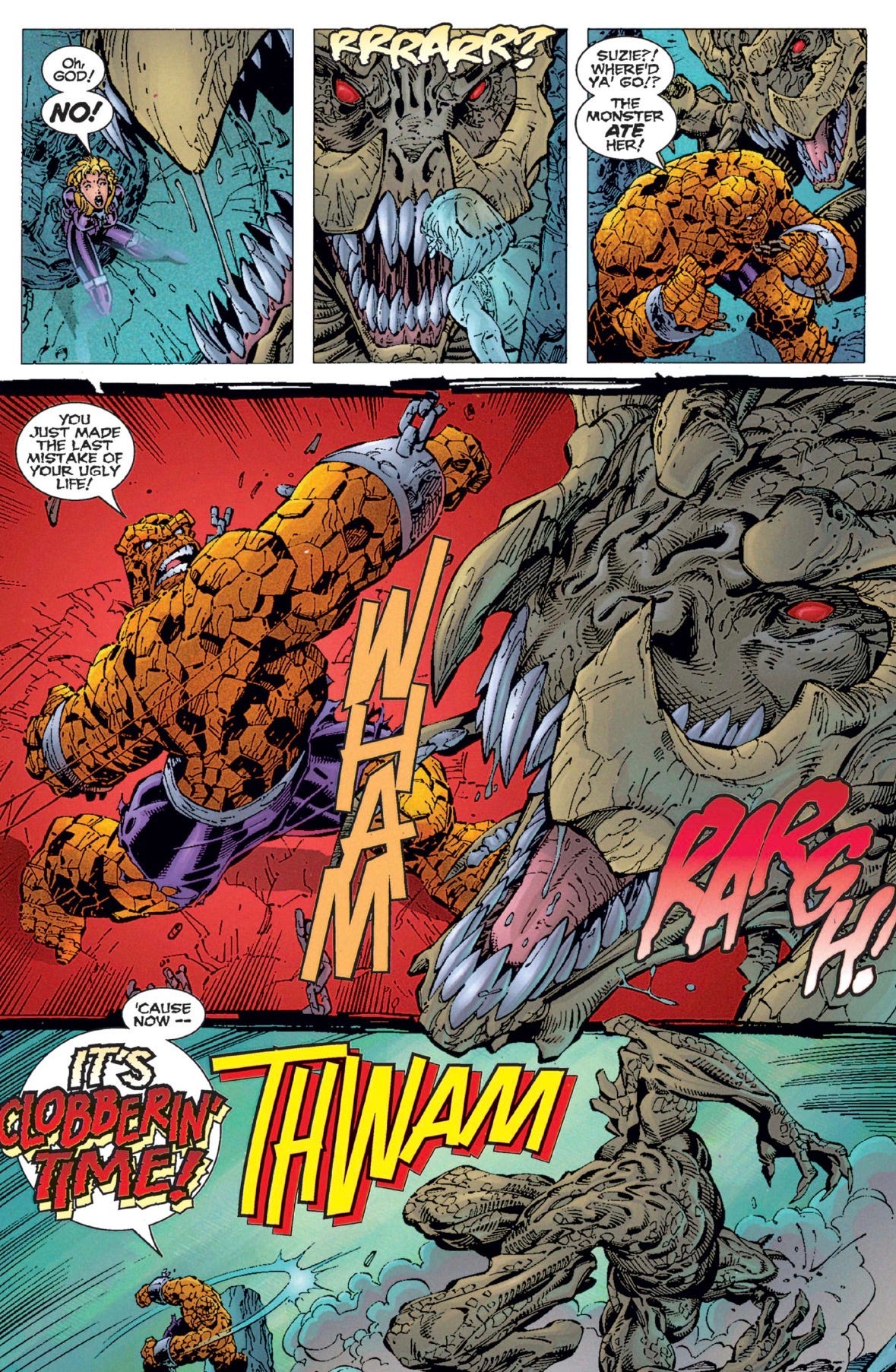
Fortunately, the second half is much more fun as the Fantastic Four gain their abilities and take on the Mole Man’s monsters and minions. It’s a decent ending for the comic, but I found it pretty lackluster overall.
Iron Man #1 by Jim Lee, Scott Lobdell, and Whilce Portacio
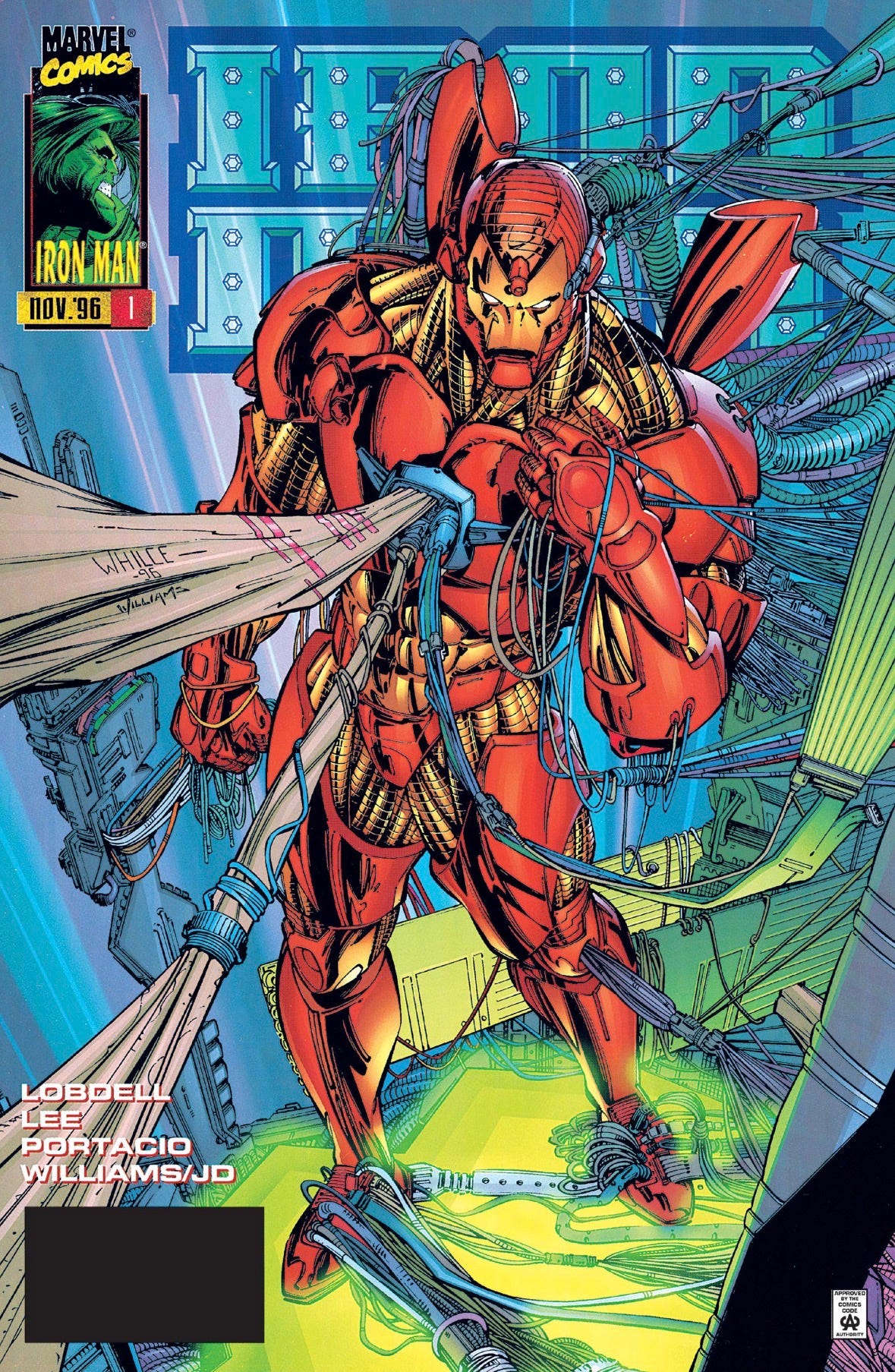
Truth be told, Iron Man was the Heroes Reborn series I was least interested in as a kid. I don’t really know why that is. I’ve just never gravitated towards the character. I guess Jim Lee wasn’t as interested in the character as he was the Fantastic Four because he is only responsible for the plotting of this issue. Scott Lobdell is responsible for the script this time around, but Whilce Portacio steps in to illustrate the book. Portacio, like Lee, was also a Marvel artist who had left to cofound Image. I really like his work on X-Factor in the pre-Image days, so it’s fun to see him back on a Marvel property.
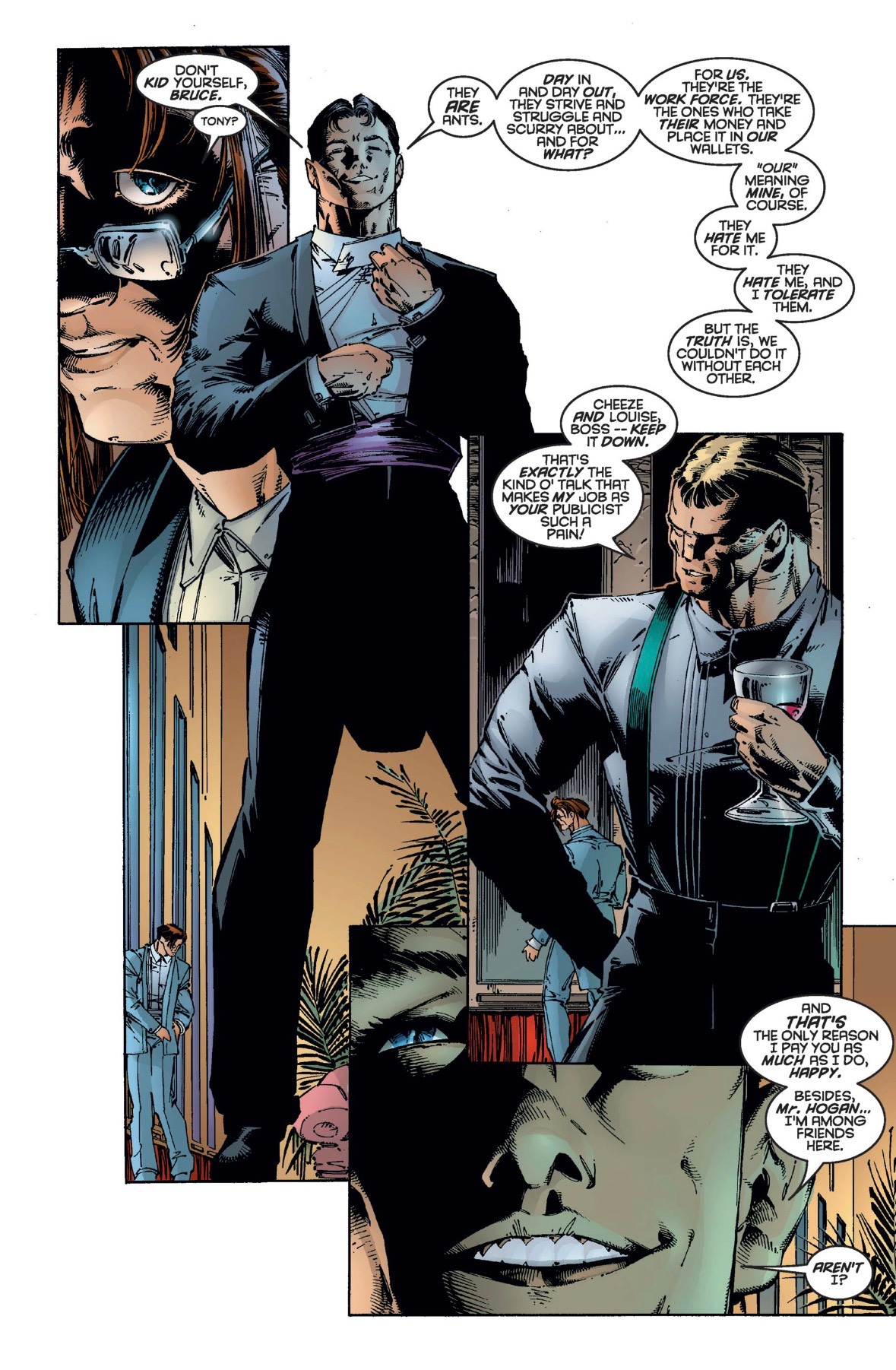
Lee definitely takes a bigger swing on Iron Man than he did with Fantastic Four. While he essentially just retold the same story as the original series with Fantastic Four #1, Iron Man #1 goes in a much different direction. Tony Stark is portrayed as a selfish asshole in this first issue to a degree that makes him virtually impossible to roof for. He’s obviously playing the long game here to tear Tony down in order to build him back up, but it feels to me like he has gone a bit too extreme with it. What’s really fascinating about this first issue is the supporting cast. I would expect characters like Pepper Potts, Happy Hogan, and James Rhodes to anchor the supporting cast with someone like Mandarin or Crimson Dynamo as the antagonist. While Pepper and Happy are present in this issue, the bulk of the supporting cast is made up of characters typically associated with the Hulk. Bruce Banner, Liz Ross (no idea why they didn’t go with Betty as her name), Doc Samson, and Jennifer Walters all play prominent roles. In fact, Banner feels like a co-protagonist with Tony in this issue instead of just a supporting character. Meanwhile, the antagonist of the issue is Hydra. I don’t usually think of the terrorist organization as an Iron Man antagonist, but it works well enough.
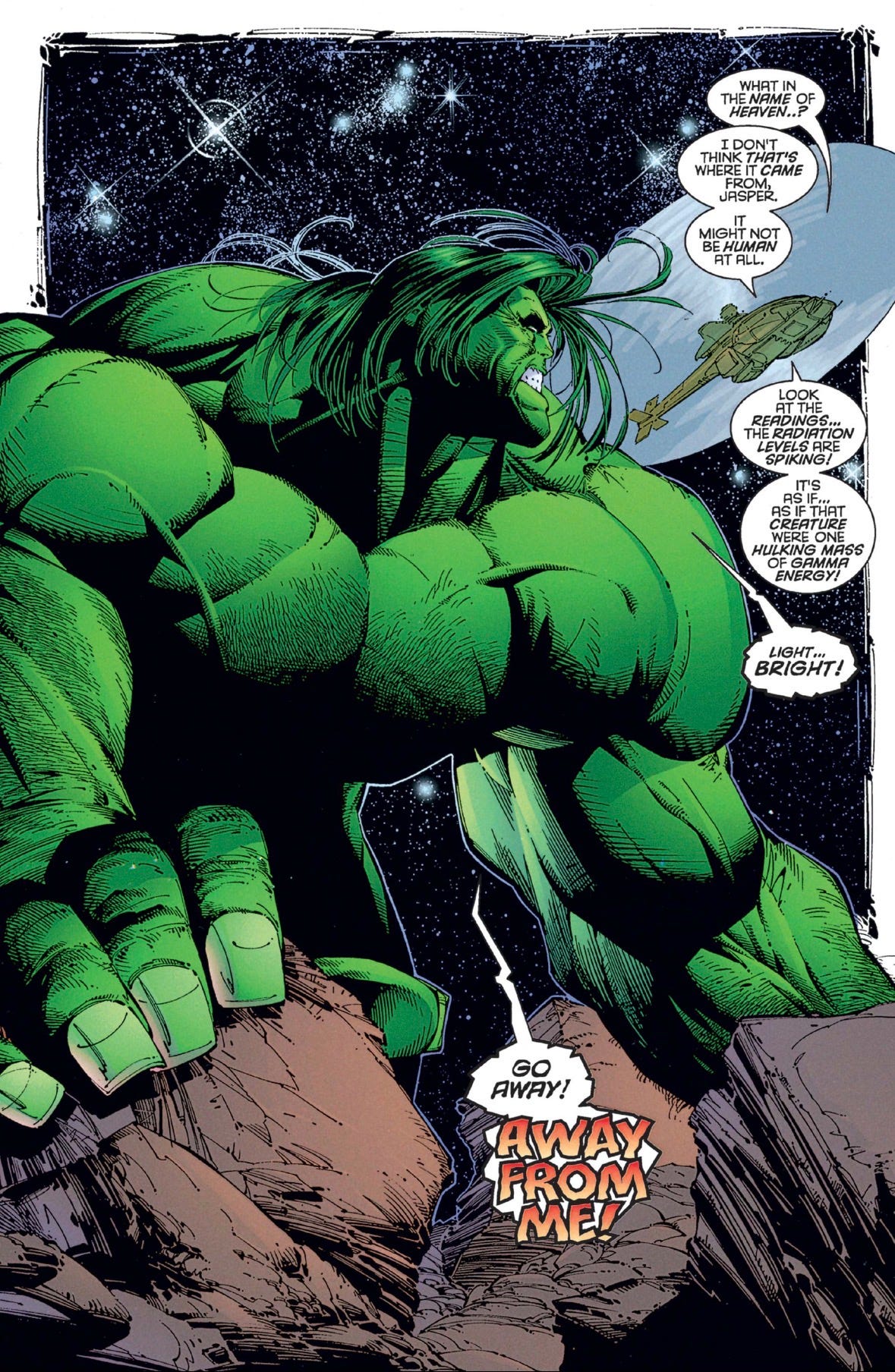
What I find especially interesting isn’t just that so many characters in this issue are more commonly associated with Hulk than Iron Man, but that the plot of this comic feels more focused on Hulk’s origin story than the titular character. I get the impression that Lee really wanted to do a Hulk comic but was told that Incredible Hulk wasn’t one of the comics being relaunched, so he just turned Iron Man into a stealth Hulk comic. We don’t even see Tony in the Iron Man armor until the final page of the issue! While this is a pretty big criticism of this book as an issue of Iron Man, I actually kind of like it as a Hulk story. It has some fun political and corporate espionage themes, and Portacio draws a cool looking Hulk. Not bad. It’s certainly more interesting than the first issue of Fantastic Four.
Captain America #1 by Rob Liefeld, Jeph Loeb, and Chuck Dixon
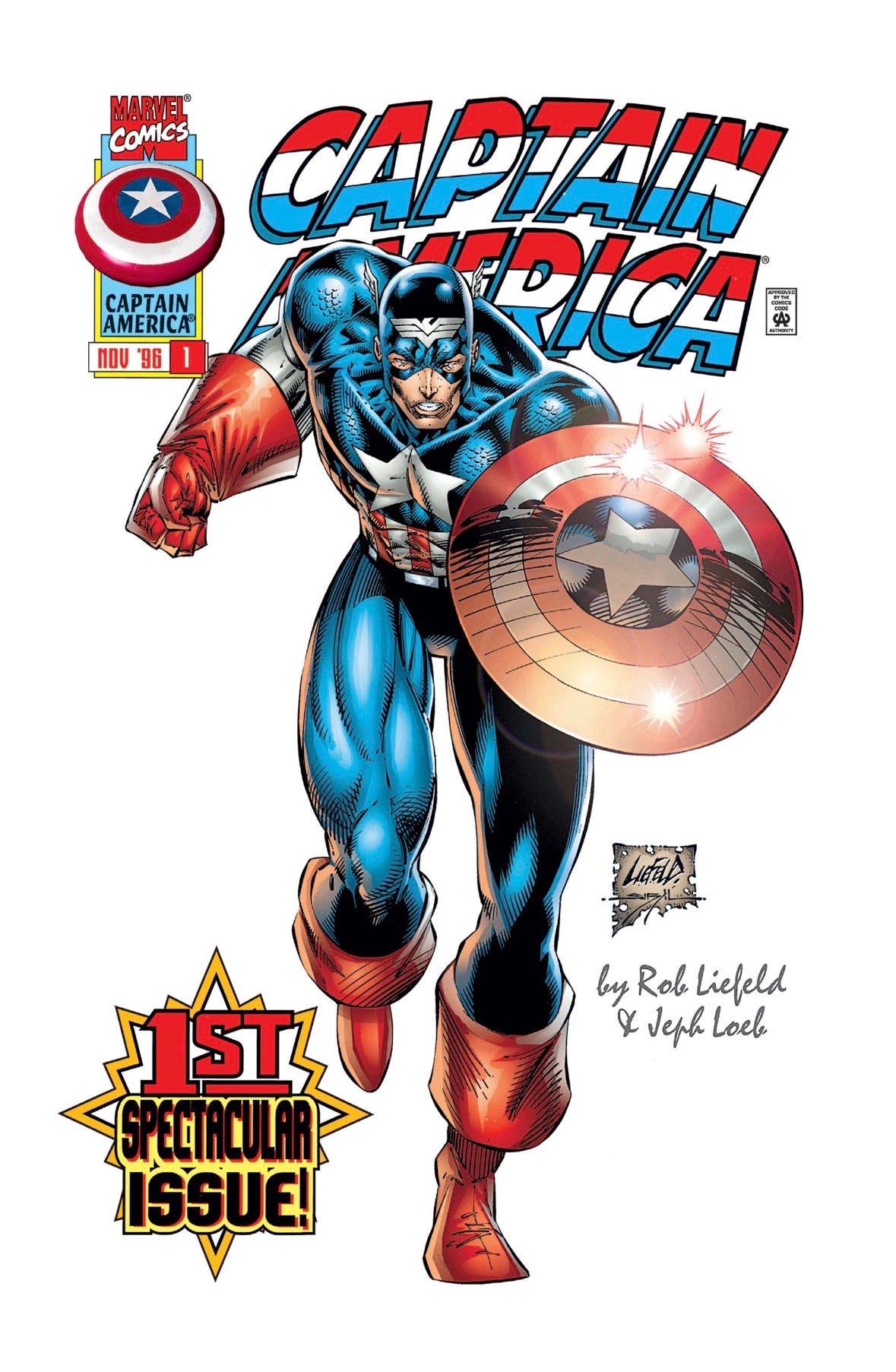
Now that we’ve covered the two books from Jim Lee’s WildStorm Productions, let’s take a look at the two from Rob Liefeld’s Extreme Studios. Since Avengers #1 already includes Captain America on the roster, we should probably start with Captain America #1. Before I get into this issue, I want to acknowledge what a lightning rod it has become over the last thirty years. Rob Liefeld is one of the most polarizing figures in the comic book industry, and this particular series has been used by his detractors for years as an example of why they dislike him. I’m going to try to be as fair as possible with my assessment here, but it’s impossible to cover it without being at least a little bit influenced by what has been said before.
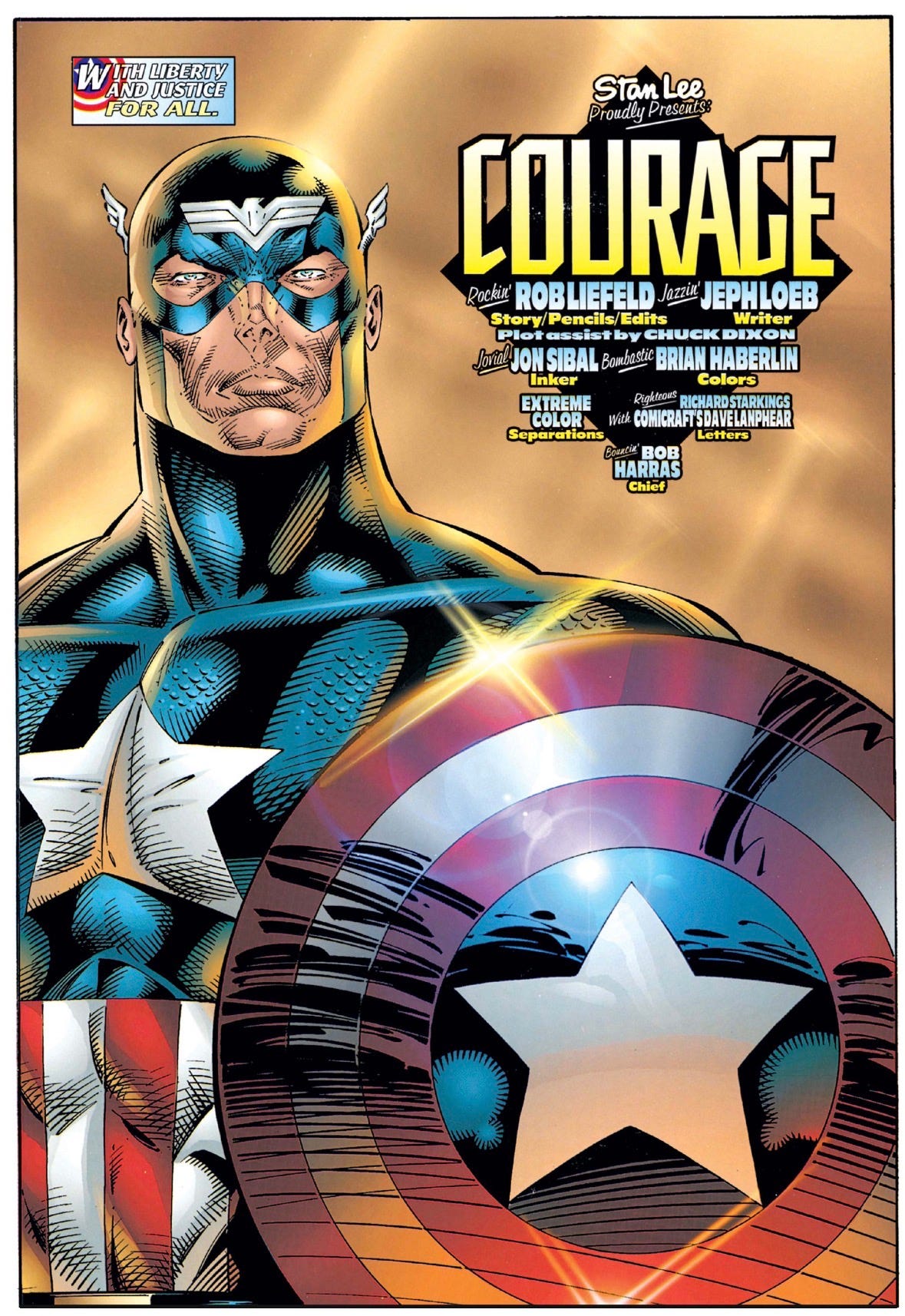
The first thing I want to highlight is the creative team. Rob Liefeld is credited with the story and pencils, Jeph Loeb is credited as the writer, and Chuck Dixon is credited with assisting with the plot. That means three different people have writing credits on one single issue of a comic, and it’s the very first issue of the series. This certainly feels like a “too many cooks” situation to me, and it is reflected in the plot here.
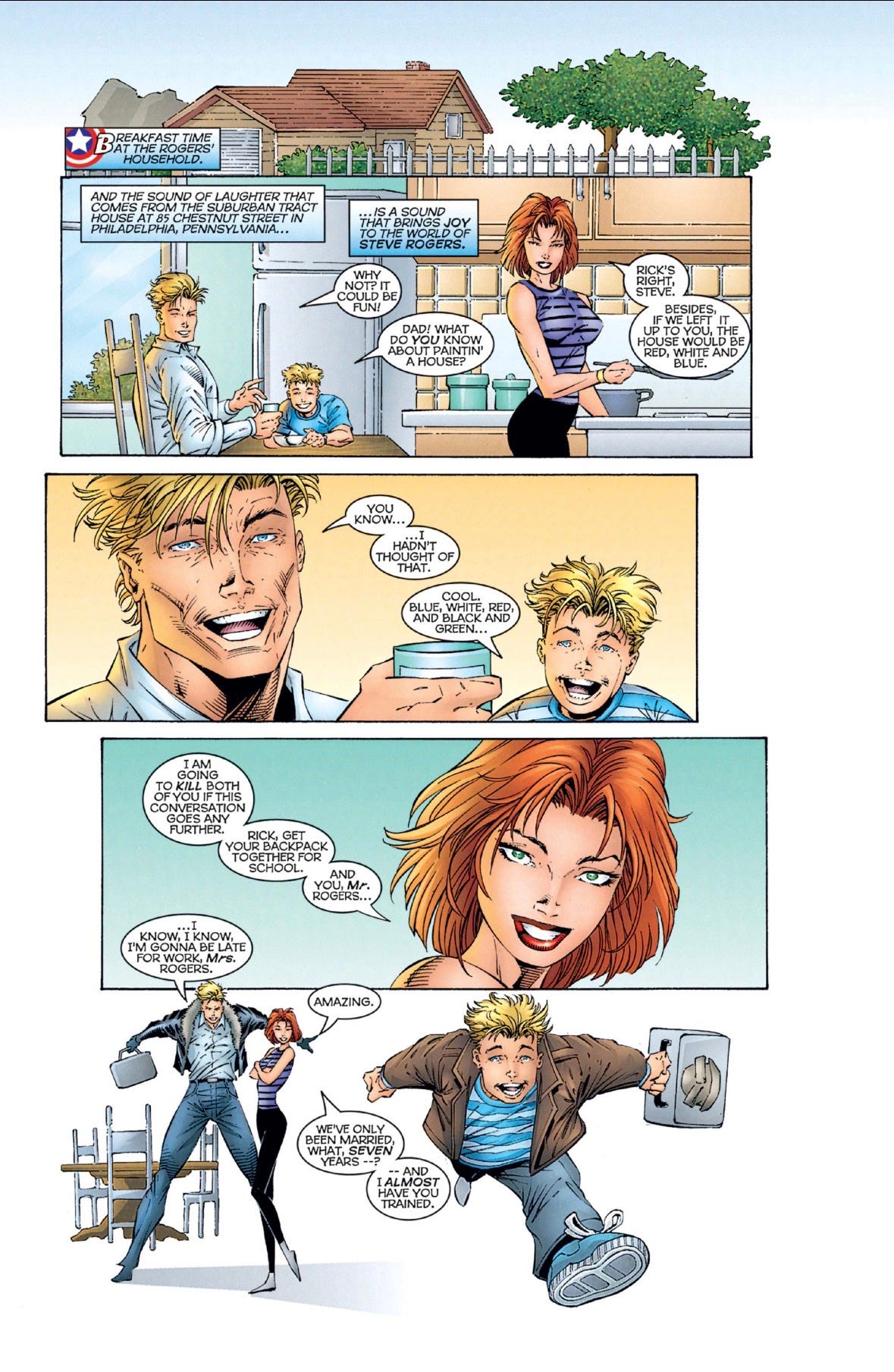
There are basically three intersecting stories here. The first is about Steve Rogers living in present day (or 1996 to be more accurate) with his wife and son in Philadelphia, but he keeps having dreams about fighting in World War II as Captain America. This version of Cap hasn’t been frozen in a block of ice since the end of the war. Instead he has had his memories wiped, and an enigmatic stranger is trying to reawaken those memories. He eventually does so by giving Cap his shield, and a big fight ensues with some kind of death squad. It’s not a bad way to communicate the classic “man out of time” nature of Cap, and it is paid off with a pretty cool fight sequence.
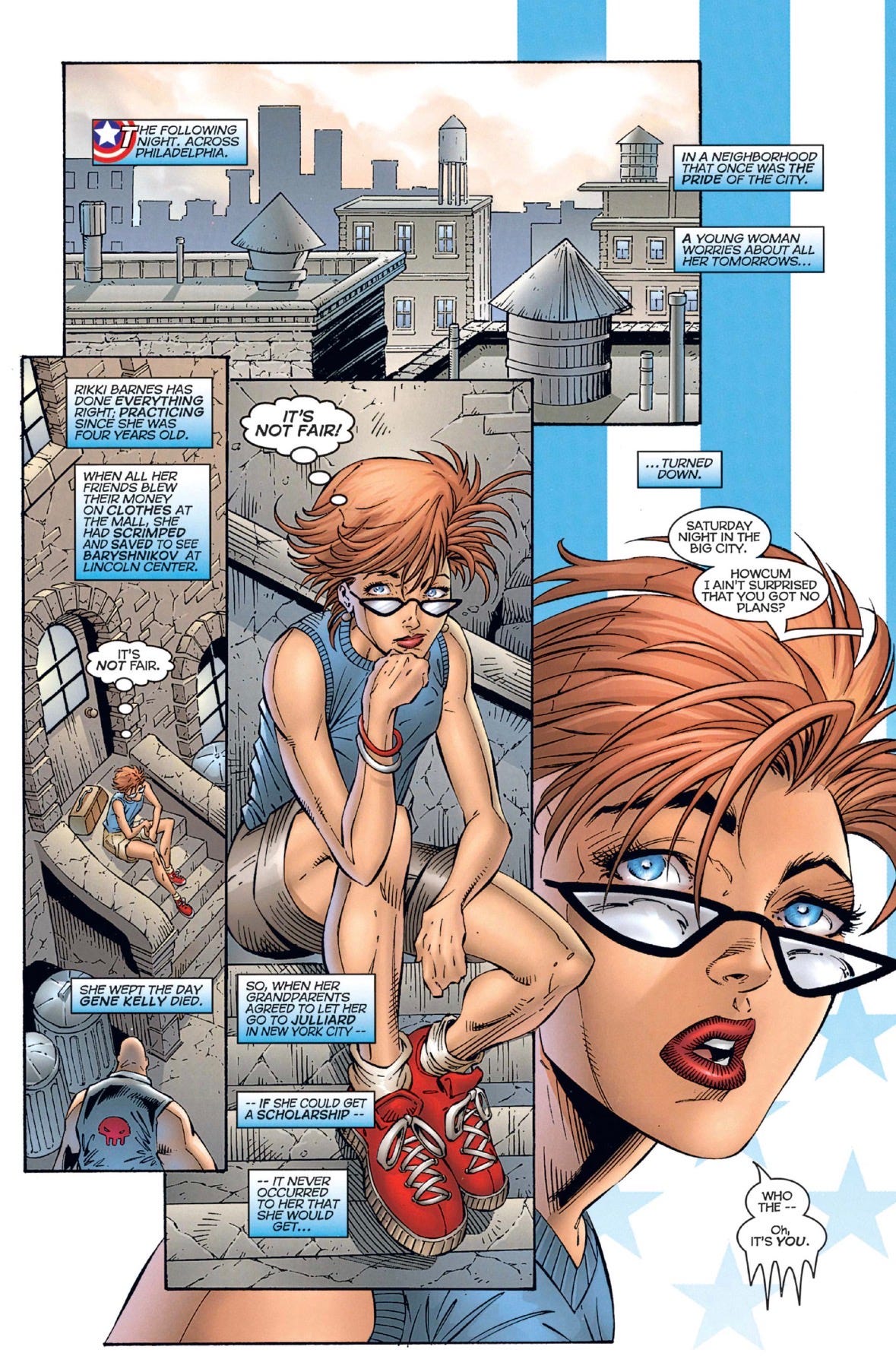
The next story within the issue revolves around a teenage girl named Rikki Barnes. As you probably guessed based on the name, she is going to be the Bucky of this universe. Her brother has joined up with a group of neo-Nazis called the World Party who wear clothes decorated with red skulls. You can see where this is going.
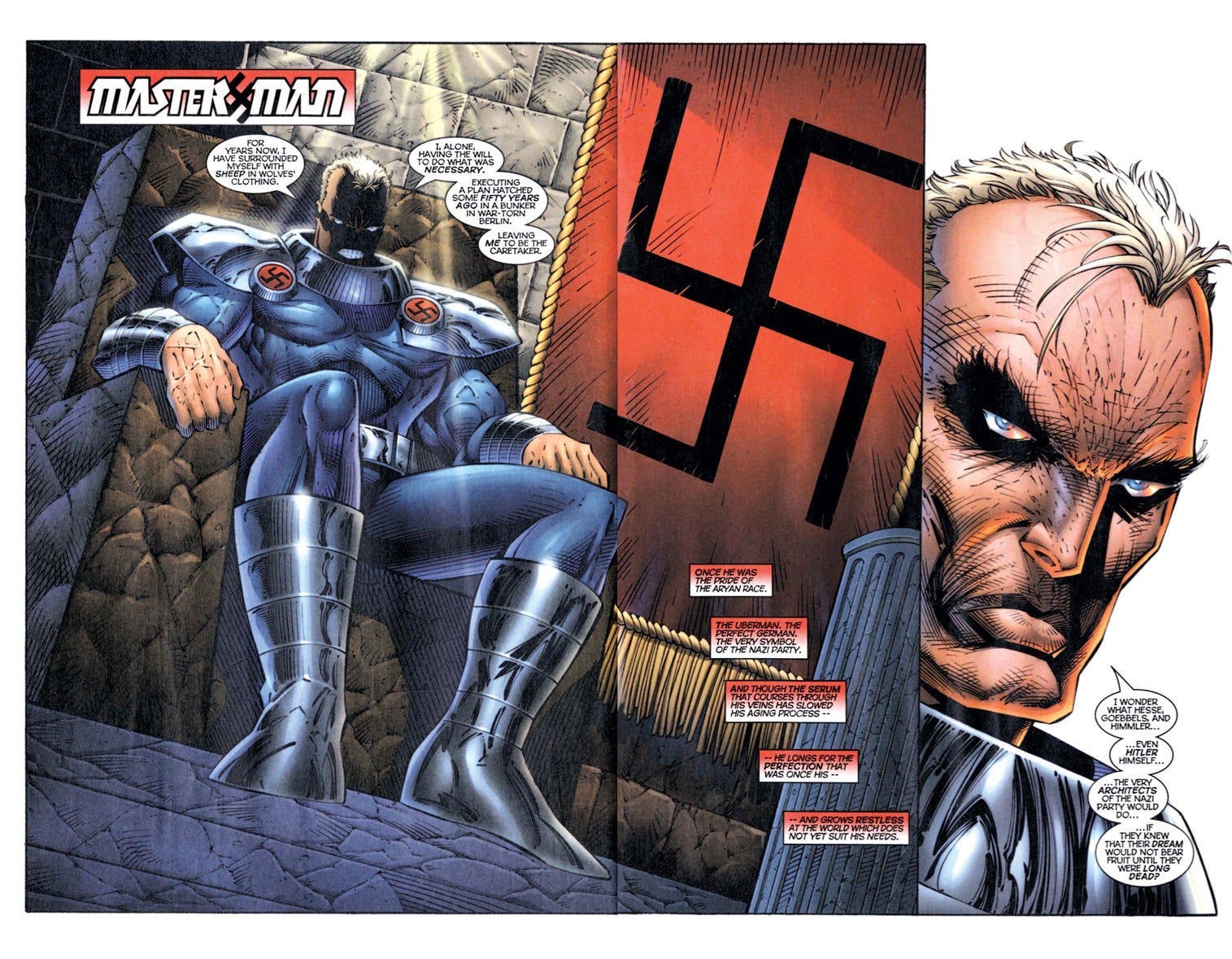
The third and final subplot is about some espionage shenanigans involving SHIELD and the World Party. The World Party somehow has a massive arsenal of nuclear warheads located at their headquarters in Philadelphia. Obviously all three of these stories will intersect as the series progresses. I think all three are perfectly fine on the surface, but the problem for me is the execution. There are way too many text boxes explaining what is happening instead of letting the art tell the story. This is a visual medium, and it works best when driven by the art.
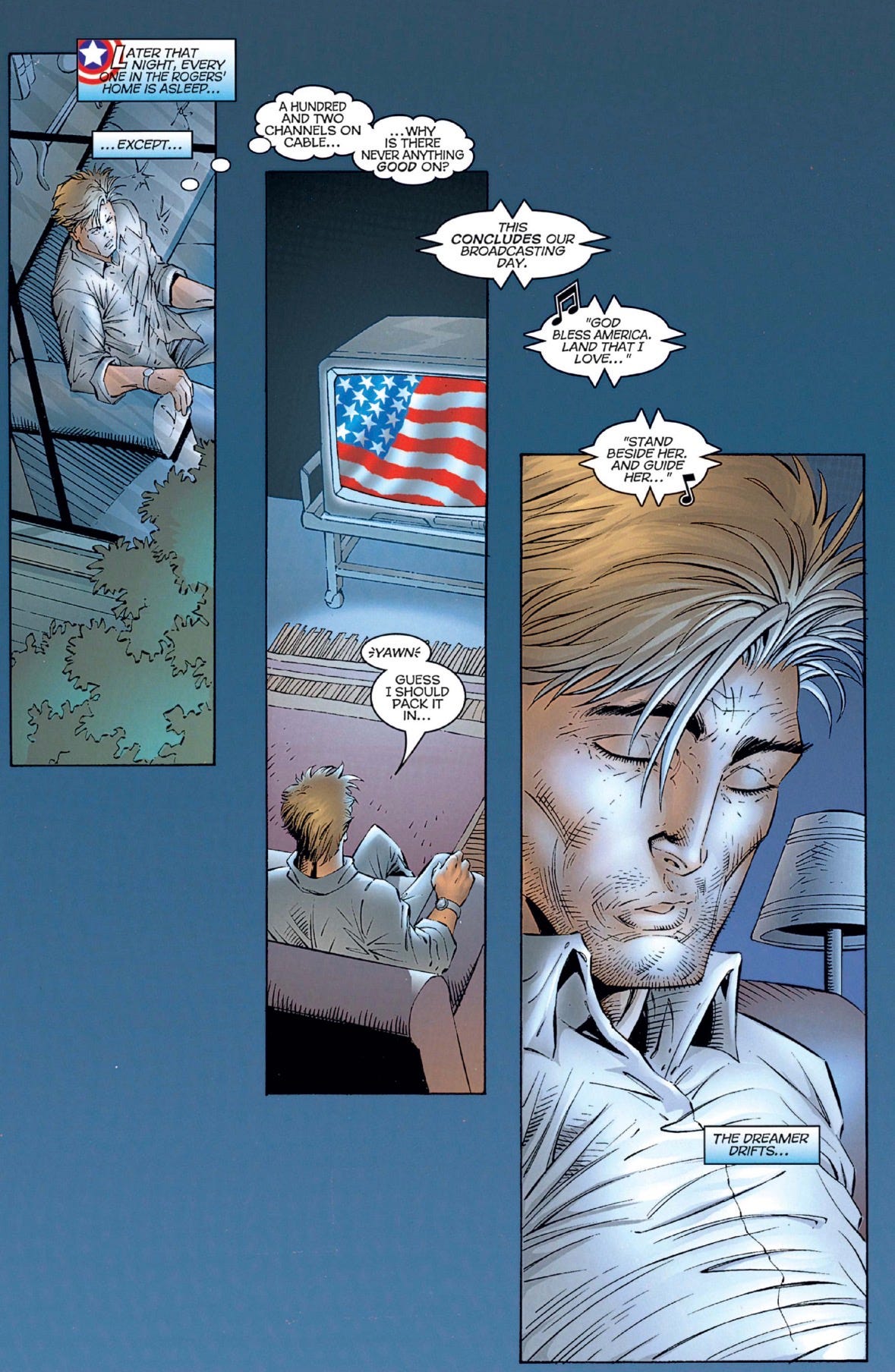
Therein lies the biggest problem with this issue. The art just isn’t up to snuff. Some pages work really well (particularly some of the action at the end of the issue), but the pages in between the action feel incredibly rushed. They lack backgrounds and feature characters with bizarre proportions and weird poses. These are common complaints when it comes to Liefeld’s style. It either works for you or it doesn’t, and it just doesn’t work for me.
Avengers #1 by Rob Liefeld, Jim Valentino, and Chap Yaep
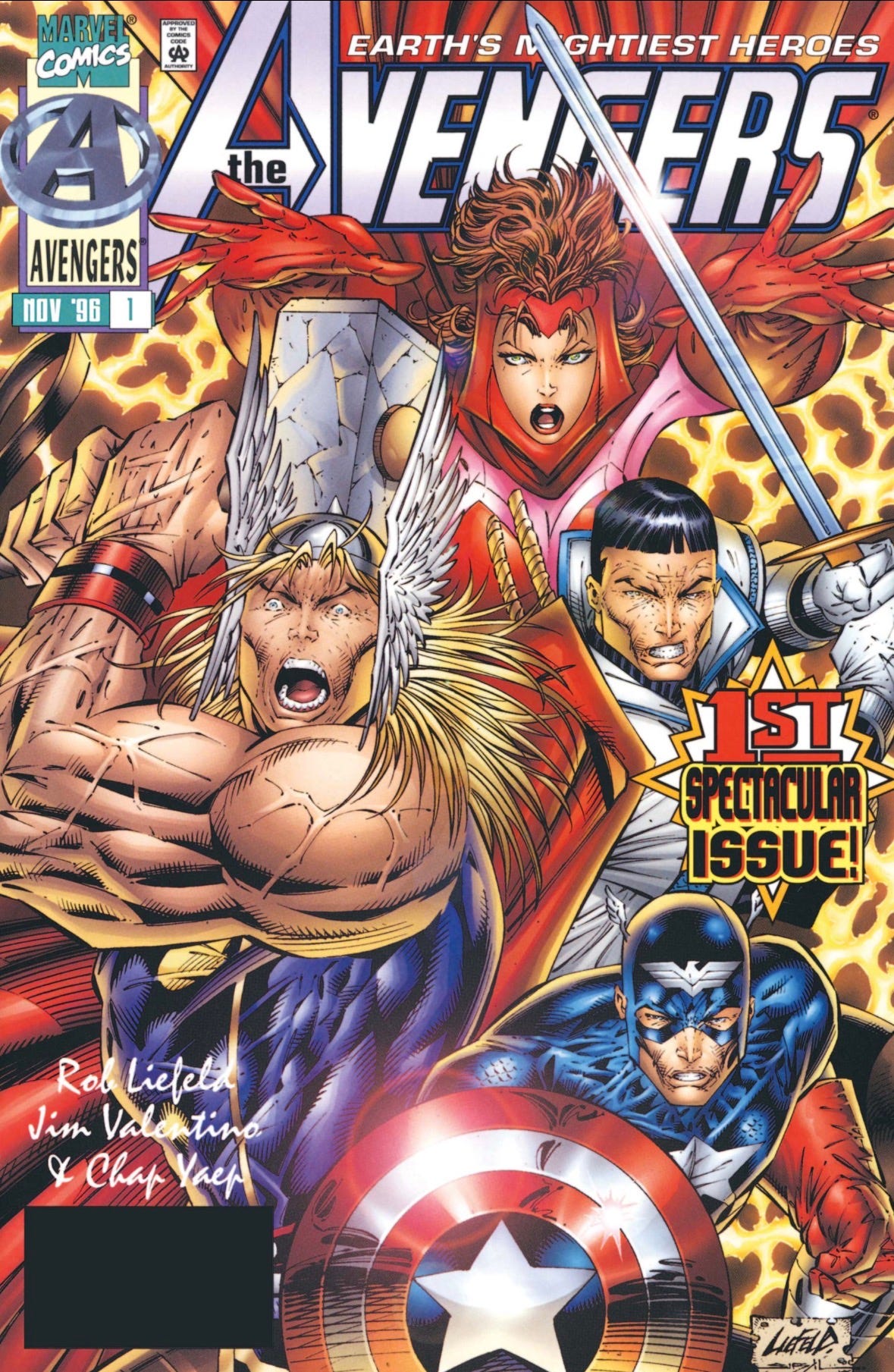
Last but not least, we have Avengers #1. The creative team for this one is Rob Liefeld on story and pencils (but he only illustrates pages 20-41), Jim Valentino on script, and Chap Yaep on pencils (but he only illustrates pages 1-19). Let me start by saying I’m not sure why Liefeld had Yaep only illustrate the first half of the book. Lee seemed comfortable with letting Portacio take the reins on Iron Man so he could focus on Fantastic Four, but Liefeld seemingly wants to illustrate both of his titles to some degree. I don’t have a problem with this division of labor in general, but this does become distracting as the series progresses and new artists and writers seem to hop on the book issue by issue.
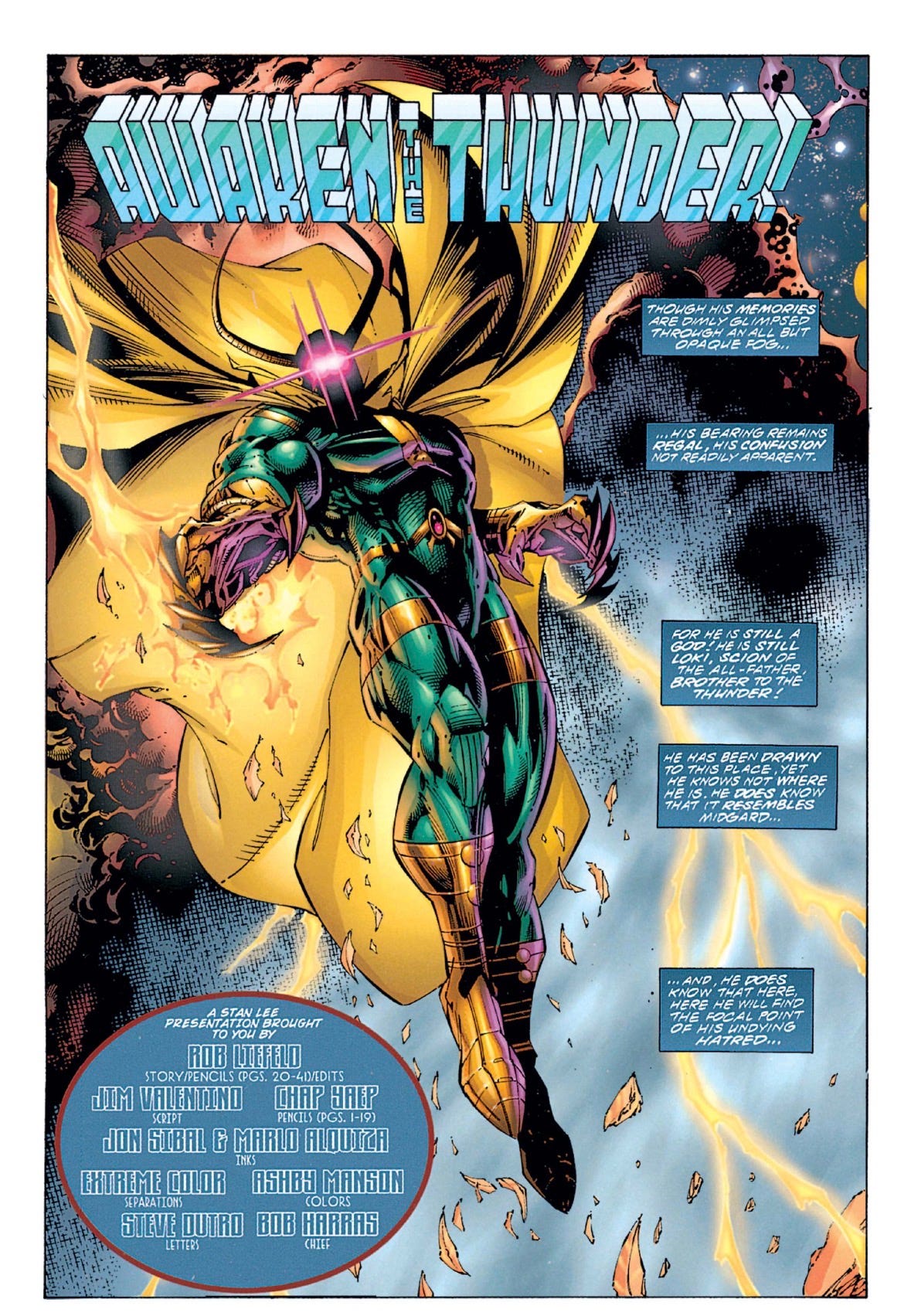
The premise of this issue is that Loki awakens in a confused state and is baffled that he can’t seem to locate Asgard or the other realms other than Midgard (Earth). We know it’s because this is all taking place within Franklin’s little pocket universe. He goes looking for Thor and finds him trapped in a block of ice. I guess Liefeld still wanted to use the guy trapped in ice gimmick that he jettisoned in Captain America, so he uses it with Thor instead. The Avengers show up to investigate as well, and Thor is freed from his icy prison. Unfortunately, Loki tricks Thor into thinking the Avengers are the bad guys. As you probably guessed, a big fight ensues.
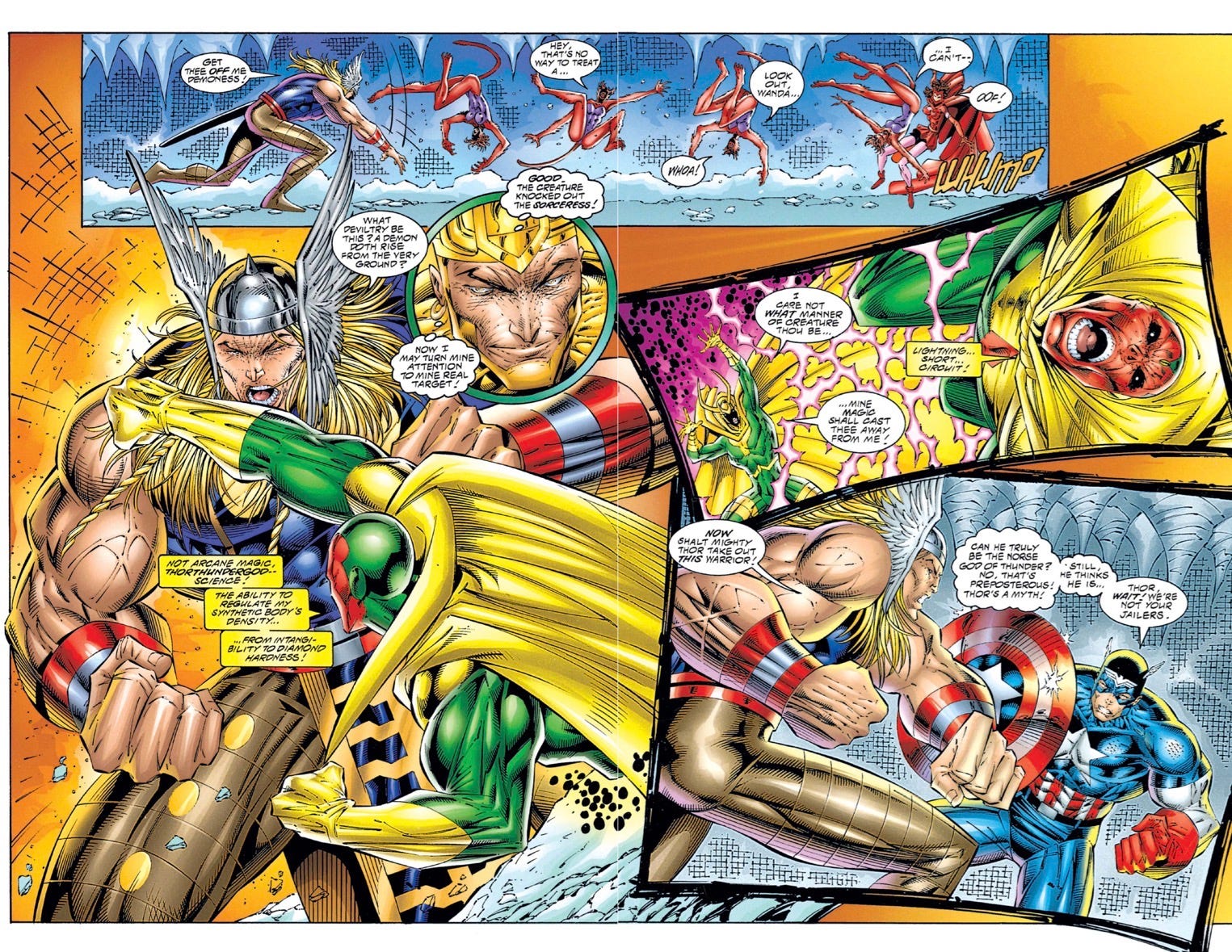
Thor eventually reclaims Mjolnir, and this restores his memories that Loki is the worst brother ever. He turns on Loki, joins the Avengers, and everybody cheers. Gotta love a happy ending.
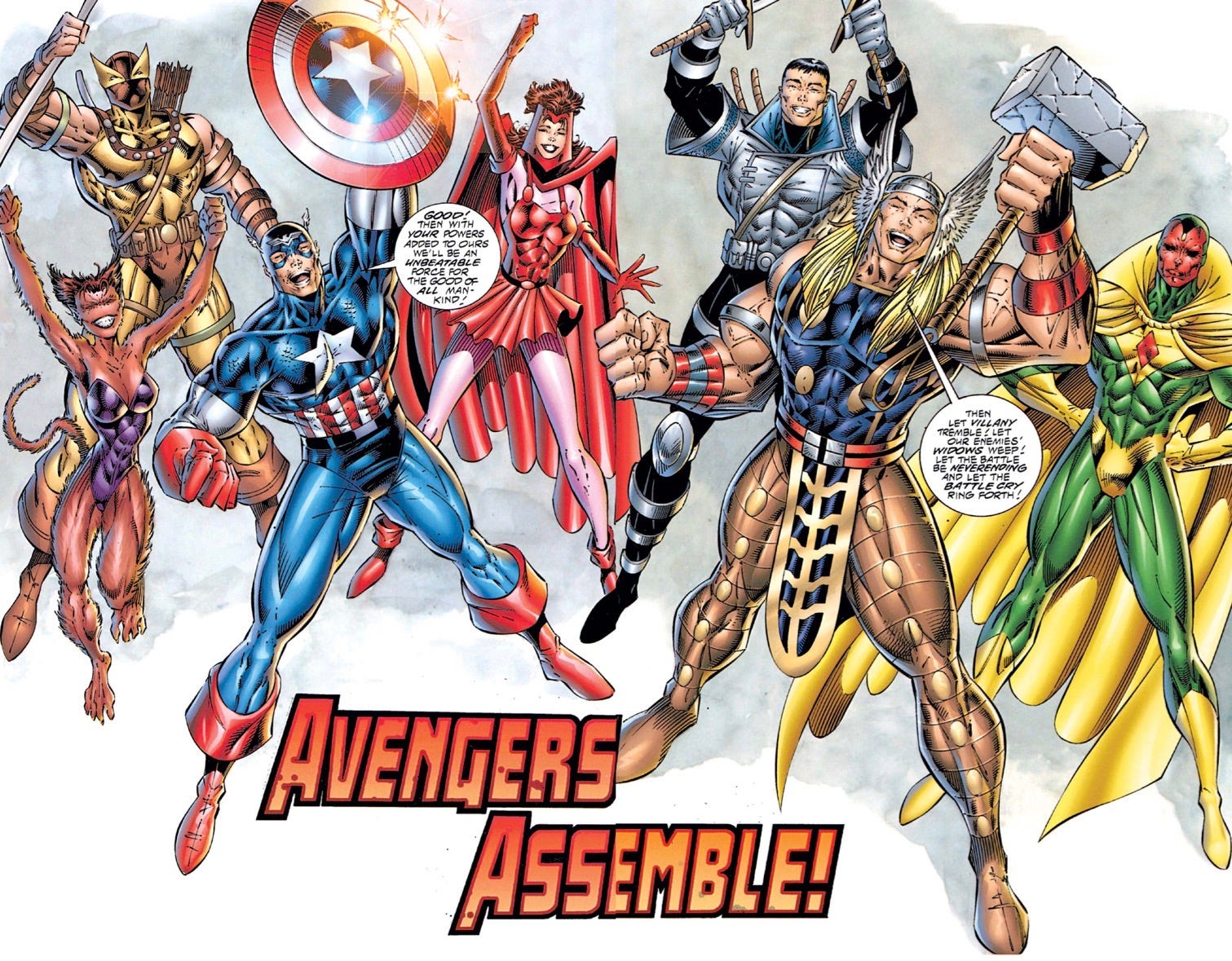
I like this issue far more than Captain America #1. It’s much more straightforward, and the art is much more consistent and detailed even though it’s done by two different artists. This issue is still far from perfect (some of Liefeld’s worst artistic traits are on display), but it feels much more like a classic issue of Avengers instead of trying to be something completely new.
Our journey through the Onslaught event and the subsequent Heroes Reborn initiative has finally reached its conclusion. As the title of this series has alluded to, Onslaught had major ramifications on what Marvel Comics would become in the twenty-first century. Events enveloping the entire publishing line would become the standard as opposed to being contained within just one line of books. Comics like House of M (2005), Civil War (2006-07), Siege (2010), Secret Wars (2015-16), King in Black (2020-21), One World Under Doom (2025), and many more would all follow this template. The Heroes Reborn reboot would also create the template for two extremely successful initiatives at Marvel shortly thereafter. The Marvel Knights imprint would hand multiple titles and characters over to Jimmy Palmiotti and Joe Quesada of Event Comics in 1998 to breathe new life into books that had fallen out of favor. While still set within the main Marvel continuity, they featured more mature storytelling from creative teams that had come up through indie comic book publishers. Not long after that, a new attempt at a Heroes Reborn style relaunch would take place with the Ultimate line of comics. This line would feature series that reimagined classic Marvel characters as if they had been created then as opposed to the 1960s. Books like Ultimate Spider-Man (2000) by Brian Michael Bendis and Mark Bagley, Ultimate X-Men (2001) by Mark Millar, Adam Kubert, and Andy Kubert, and The Ultimates (2002) by Mark Millar and Bryan Hitch all became massive hits that greatly influenced the Marvel Cinematic Universe. It’s difficult to imagine the behemoth that Marvel has become today without the foundation laid in 1996.
Thanks for your summary and commentary of the Heroes Reborn line. I can see how - instead of being more like an Ultimate or Absolute title - it was just a "modernized" version of classic Lee and Kirby tales. No wonder it didn't last ... the creators probably lost interest on such a vanilla project.
This was a cool write-up and a nice trip down memory lane. I wasn't regularly reading comics at this point, but Onslaught was when I definitely started dipping my toes into the water. I picked up many of the key X-Men issues during this time and both Onslaught: X-Men and Onslaught: Marvel Universe, so I ended up reading a truncated version of it. Wasn't until years later that I would read the whole thing properly.
And honestly? I still kind of dig it. It's flawed, but I have a soft spot for it. And I still really like the idea that the infamous X-Traitor subplot that had been introduced with Bishop paid off and was revealed to be Xavier.
Of the Heroes Reborn stuff, I had fun with FF and Iron Man. Less so with Cap and Avengers. I've heard they get better after Liefeld is forced out, but I haven't been able to get past the Liefeld issues just yet.