
Snatchin’ Bodies
An exploration of pod people, hive minds, parasites, and assimilationists in science fiction and horror

I finally watched Pluribus. I know. I’m late to the party, but I got there eventually. If you’re not already familiar with it, Pluribus is a series on Apple TV from Vince Gilligan (creator of Breaking Bad and Better Call Saul) and starring Rhea Seahorn (best known for playing Kim Wexler on Better Call Saul). It’s a science fiction series that relies on a classic premise in the genre: humanity is being replaced or assimilated by some sort of extraterrestrial hive mind.
It’s a trope that really became popular in the 1950s, and it has never really gone out of style. We’ve seen different variations of this in various films, books, television shows, comic books, etc. in every decade since. Pluribus is just one recent example of this. Last year also gave us the young adult novel Shiny Happy People by Clay McLeod Chapman (which I also just recently finished). It explores similar themes while focusing on teenagers dealing with drug use and party culture.

These two recent entries in the subgenre got me thinking about the different ways they’ve been explored over the years. I think you can break it down into these general subgroups: replacements, hive minds, assimilationists, and parasites. Obviously there is some overlap between these as well. Anyway, this is how I see these various subgroups shaking out.
Replacements
You can also call this one the pod people subgroup. I would characterize this subgroup as being stories about some outside force (usually extraterrestrials) infiltrating human society, taking on the appearance of human beings, and then covertly replacing those human beings until all of humanity has been replaced before any kind of resistance can be mounted. This is probably the most famous version of the subgenre thanks to Invasion of the Body Snatchers. If you’re not familiar with this film and its numerous remakes, it’s a story adapted from a novel called The Body Snatchers by Jack Finney that was published in 1954. The plot is generally the same in all of the various adaptations: an alien race that resemble plant seeds is quietly invading Earth. It copies the genetic code and memories of any human they come into contact with, and then they grow exact replicas of those humans in large incubation pods. Once the pod person is fully formed, the original human body is disposed of and this replica takes their place in the world. While this replica looks identical and has the memories of the original person, it is completely devoid of emotion and personality traits. Both the novel and the adaptation Invasion of the Body Snatchers (1956) directed by Don Siegel serve as a Cold War metaphor that dares to ask the question, “What if your friends and neighbors suddenly started opposing imperialism and inequality?” Spooooooooooky!
The 1978 remake directed by Philip Kaufman (one of my favorite horror remakes) inverts the metaphor so that it’s more about the death of 1960s counterculture and its replacement with the monotonous grind of corporate culture. The 1993 adaptation Body Snatchers directed by Abel Ferrara (an underrated and underseen film in my opinion) moves the story to an American military base and lets the pod people serve as a metaphor for conformity within the military. I recommend all three of these films to anyone who hasn’t seen them.

Another example of this subgroup that has popped up in the medium of comic books are the Skrulls. These are shapeshifting aliens created by Jack Kirby and Stan Lee in Fantastic Four #2 published back in 1962. While they were a consistent threat in Marvel comic books for decades, they didn’t really embody the tropes of the replacement subgroup until Secret Invasion by Brian Michael Bendis and Leinil Francis Yu in 2008. This event comic was about how Skrulls had slowly been replacing various heroes and figures within the Marvel Universe on Earth for years without anyone noticing. There was also a Disney+ series by the same name that loosely adapted that story.
One last example I wanted to touch on was the John Carpenter classic They Live from 1988. While only loosely fitting into this subgroup, I think it shares enough DNA to be included. This film features an alien race that has infiltrated human society by using a frequency that makes it so humans think they look like humans themselves, and they occupy positions of power throughout the world in order to turn humanity into an unwitting workforce to bolster their wealth and power. Humanity is blind to the fact that they are serving the interests of a tiny percentage of alien invaders instead of their own. Hopefully I don’t need to explain the metaphor here.
Hive Mind
This is the subgroup that Pluribus falls into. The characteristics of this one differ from replacements in that the individuals impacted are infected and have their minds added to a singular network of consciousness as opposed to having duplicates replace them. I think the most famous example of this would be the Borg from Star Trek: The Next Generation. They first popped up in the episode “Q Who” in 1989 during the show’s second season, and they’ve been a Star Trek mainstay ever since. They are essentially cybernetic organisms that belong to a hive mind known as the Collective, and they can infect organic life forms and turn them into cyborgs that add them to the hive mind. They’re also the primary antagonists in Star Trek: First Contact (1996) directed by Jonathan Frakes. I’m admittedly not super familiar with Star Trek, but I’m pretty sure fans of the franchise hold this film up as the greatest entry across all forms of media.
I’d also include The World’s End (2013) directed by Edgar Wright as part of this subgroup. This one obviously veers into comedic territory, but there are still plenty of science fiction thrills to be had. Similar to the Borg and the Collective, the antagonists in this film are also a bunch of cybernetic drones controlled by a hive mind called the Network. The chief difference is that the human victims in this film are turned into cyborgs who still look exactly like their original human selves in order to blend in. They’re more similar to the pod people in the various Invasion of the Body Snatchers films in that regard.
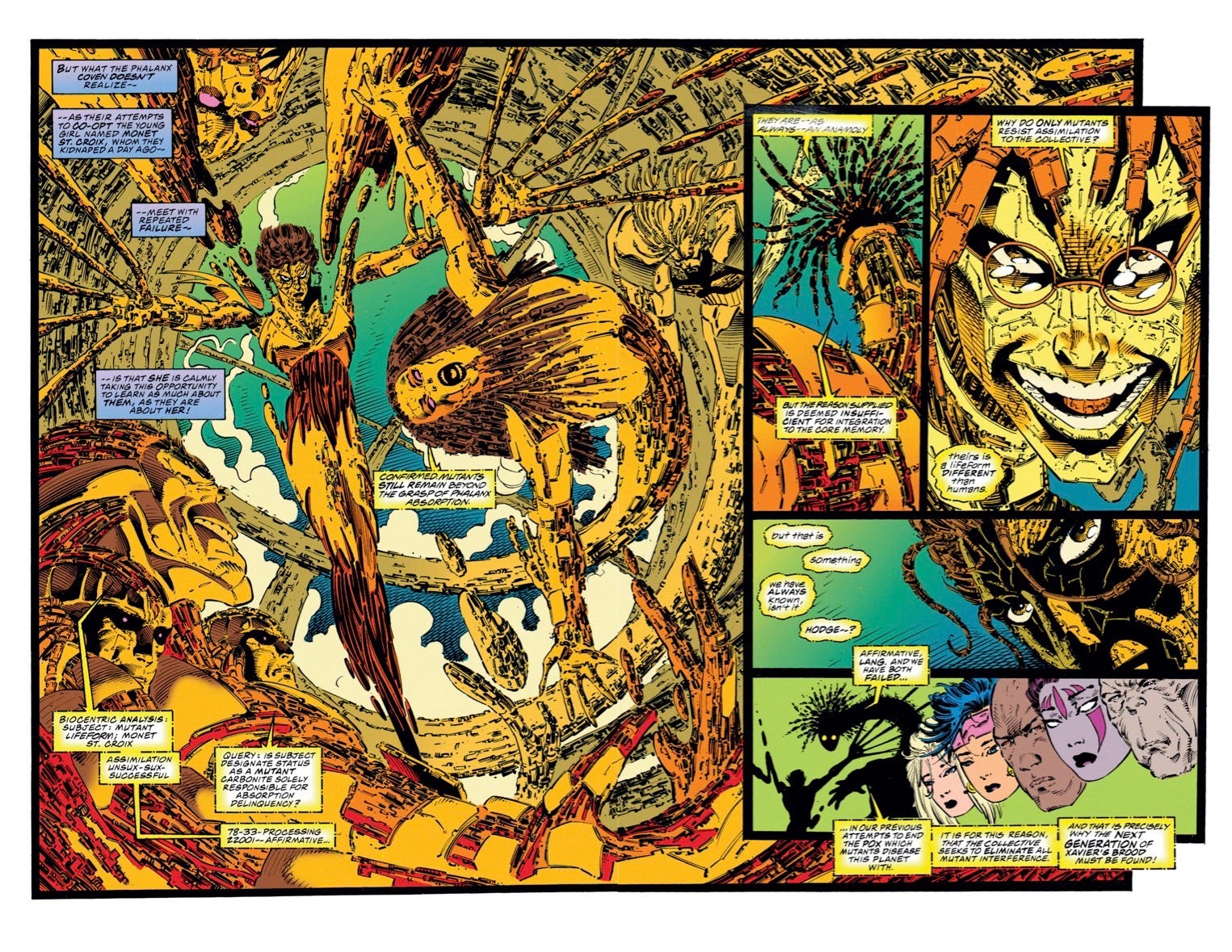
The last example I’d like to mention is the Phalanx from Marvel Comics. Created by Scott Lobdell and Joe Madureira, they are a race of techno-organic extraterrestrials that infect and absorb other life forms. Humans who are infected seem to retain some of their personality traits, but their motivations become entirely to serve the greater hive mind. They’re probably best remembered for being the primary antagonists in the “Phalanx Covenant” crossover event in 1994, but they also played an important role in the Powers of X comic book series from Jonathan Hickman and R.B. Silva in 2019.
Assimilationists
I’d characterize this subgroup as including life forms (usually extraterrestrial) that are able to absorb and assimilate humans into themselves. The original human is effectively killed in the process. The most obvious example of this is John Carpenter’s The Thing (1982) as well as the novella it was adapted from. I’ve already written way too much about this in the past, so I’ll keep things brief here. The important thing to note is that the alien creature in this case is able to absorb and perfectly replicate any living organism it comes into physical contact with. Its motivations are completely unclear aside from a seemingly insatiable drive to just keep assimilating different organisms to add to its bouquet of genetic material.
Another example would be the 1999 movie Virus directed by John Bruno and the 1992 comic book by Chuck Pfarrer and Howard Cobb that it was based on. Anyone remember this one? Where my Virologists at? I’m just assuming that’s what fans of the movie call themselves. This movie is admittedly not very good, but it does have an interesting antagonist at least. This time it’s some sort of sentient extraterrestrial electricity that got beamed down from a space station to a ship in the Pacific Ocean. It moves through the electrical equipment on the ship and assimilates both the machinery and the human crew to create biomechanical monstrosities. Pretty neat!

The last example I wanted to discuss is a very recent novel from Sarah Gailey called Spread Me. This book has a lot in common with The Thing. Just replace the snowy setting with a desert one and an extraterrestrial threat with a seemingly sentient virus that infects and mutates the host into a carrier that attempts to manipulate the friends and loved ones of the host to get close enough to infect them. It’s a nasty little combination of body horror and erotic horror that I highly recommend.
Parasites
The last little subgroup I’ve created is probably the easiest to interpret by the name. It’s characterized by some sort of parasitic organism wriggling its way into a human body and taking control of them. One of my favorite examples of this is David Cronenberg’s Shivers (1975). Much like Spread Me, this is a rather disgusting movie about a genetically engineered parasite that is transmitted through sexual contact. Once it gets inside a host, it turns up their sex drive to extreme levels. This essentially turns the person into a sex obsessed zombie who will do anything to pass on the parasite to someone else. It’s truly horrifying.
Another more fun example of this subgroup is The Faculty (1998) directed by Robert Rodriguez. This movie is an obvious love letter to movies like Invasion of the Body Snatchers and The Thing, but it focuses on teenagers instead of adult protagonists. It’s about some sort of extraterrestrial organism that resembles a mollusk that infects the teachers at a high school in suburban America. These teachers begin behaving similarly to the pod people from Invasion of the Body Snatchers as they attempt to infect more and more people in the community with the ultimate goal of world domination. It’s a pretty fun little movie that never takes itself too seriously. It also has a phenomenal cast.
The last examples I wanted to highlight are a pair of horror-comedies with very similar antagonists. Those would be Night of the Creeps (1986) directed by Fred Dekker and Slither (2006) directed by James Gunn.
Let me start by saying that I am a fan of both of these films. They have sharp scripts, great casts, and pretty gnarly special effects. Night of the Creeps is an homage to 1950s science fiction movies that is set predominantly on a college campus. Slither is more of an homage to 1980s science fiction films that is set in a rural town in South Carolina. What the two movies have in common are their antagonists. Both feature extraterrestrial slugs that wriggle their way inside human beings through any exposed orifices, turning them into mind controlled zombies. In the case of Night of the Creeps, they are literal zombies. The slugs kill the hosts and turn them into incubators to produce more slugs as they shamble around searching for more victims. In the case of Slither, the infected hosts still move around and speak like people. They are just controlled by the original organism that has turned its host into a huge anthropomorphic squid monster thing. Very normal. Night of the Creeps and Slither also feature protagonists who are sarcastic cops that are sick of this shit (Tom Atkins and Nathan Fillion respectively). What I’m saying is you should watch both of these movies because they are very fun.
I honestly recommend checking out all of these movies, shows, books, and comics. Maybe not Virus, but definitely the others! Just make sure to keep an eye on the people in your life. You never know when they might start acting just a little bit strangely…